Metabolic · 6 min read
Glucomannan: the fibre with an authorised claim, and the meta-analyses that keep it honest
Vekovia · 13 September 2026
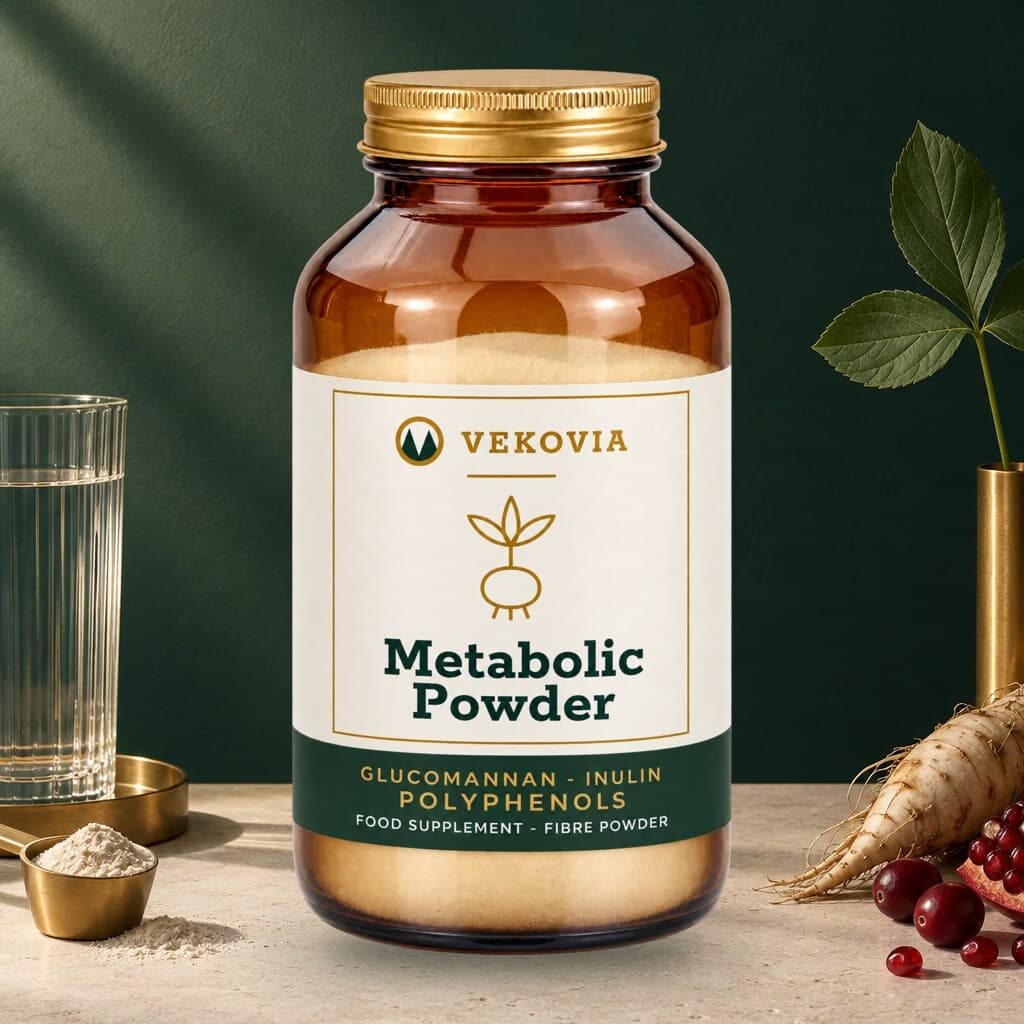
Most "weight management" supplements are built on ingredients that have never been assessed by anyone. Glucomannan is the exception, and the exception is instructive: it has an authorised European health claim, the claim is narrow, and the evidence underneath it is smaller than the marketing around it. This post is about all three of those things at once.
What it is
Glucomannan is a soluble fibre from the root of the konjac plant, Amorphophallus konjac. Its defining property is physical rather than chemical: in water it swells to many times its dry volume and forms a viscous gel. Taken before a meal with enough water, that gel occupies space and slows the passage of food. It is fermented by gut bacteria further down, but the reason it appears in the literature is the gel.
The claim, exactly
Under Regulation (EU) 432/2012, the authorised wording is:
Glucomannan in the context of an energy-restricted diet contributes to weight loss.
Every word in it is load-bearing. The claim may only be used for a food that provides 3 g of glucomannan a day, in three doses of 1 g, each taken with one to two glasses of water before a meal, and only in the context of an energy-restricted diet. It also comes with a mandatory warning: the fibre must be taken with plenty of water, because a gel that forms too early can cause choking, and people with swallowing difficulties should not take it at all.
That is the sentence on the Metabolic Powder label, with its conditions beside it. It is the reason the product contains exactly 3 g and is dosed three times a day, and the reason the directions say before meals and with water more often than reads elegantly.
What the trials found
The European Food Safety Authority based its 2010 opinion on randomised trials of glucomannan in overweight adults. Pooled, those trials show an effect, and a small one.
A 2008 meta-analysis of fourteen trials found that glucomannan lowered total and LDL cholesterol, lowered fasting glucose, and reduced body weight by about 0.8 kg versus control (Sood et al., 2008). A 2015 systematic review of six trials found that in overweight adults there was some evidence of a short-term reduction in body weight, but not in body mass index, and that only one trial showed the effect at more than a single time point (Zalewski et al., 2015).
And a 2014 meta-analysis of eight randomised trials in overweight and obese adults found no statistically significant difference in weight loss between glucomannan and placebo (Onakpoya et al., 2014). Its authors concluded that the available trials do not show glucomannan generating statistically significant weight loss.
So: an authorised claim, and a body of evidence that says the effect is modest, conditional on a reduced-calorie diet, and — in the most conservative reading — possibly not distinguishable from placebo at all. We do not think those facts contradict each other. The regulator assessed the trials and authorised a claim worded as carefully as the evidence allows. We use that wording and none other.
The chromium in the same formula
Metabolic Powder also contains chromium, which carries two authorised nutrient-function claims: it contributes to normal macronutrient metabolism and to the maintenance of normal blood glucose levels. Those are statements about what the mineral does in the body at a reference intake. They are not statements about what a supplement does to a person's blood sugar — and a 2014 meta-analysis of sixteen trials found that chromium supplements had no measurable effect on fasting glucose in people with or without diabetes (Bailey et al., 2014). We cite that next to the claim on purpose.
What this product is, and is not
Metabolic Powder is a fibre formula — 3 g of glucomannan, 9 g of chicory inulin and 2 g of PHGG — with cranberry and pomegranate polyphenols and three dosed micronutrients. It is not a fat burner, it contains no stimulant, and it does not replace the reduced-calorie diet the claim itself is conditional on. Taken as directed, with water, before meals, it provides a viscous fibre with an authorised claim and a fermentable fibre dose that capsules cannot.
If you are looking for a promise, this is not the page. If you want to know exactly what the EU let a fibre say about weight, and how much the trials support it, it is.
References
- Sood N et al. Effect of glucomannan on plasma lipid and glucose concentrations, body weight, and blood pressure: systematic review and meta-analysis. Am J Clin Nutr 2008. PMID 18842808. DOI · PubMed
- Onakpoya I et al. The efficacy of glucomannan supplementation in overweight and obesity: a systematic review and meta-analysis of randomized clinical trials. J Am Coll Nutr 2014. PMID 24533610. DOI · PubMed
- Zalewski BM et al. The effect of glucomannan on body weight in overweight or obese children and adults: a systematic review of randomized controlled trials. Nutrition 2015. PMID 25701331. DOI · PubMed
- Bailey CH Improved meta-analytic methods show no effect of chromium supplements on fasting glucose. Biol Trace Elem Res 2014. PMID 24293356. DOI · PubMed