The Science
Everything we say about Akkermansia traces back to a published study. Here is the evidence, with the source for each finding, so you can read it yourself.
What Akkermansia muciniphila is
A gut bacterium first described in 2004 by Derrien and colleagues in Wageningen, named for the mucus layer it lives in and feeds on. Over two decades it has become one of the most-studied microbes in metabolic and longevity research, with its own reviews in Nature Reviews Gastroenterology & Hepatology and Nature Reviews Microbiology.
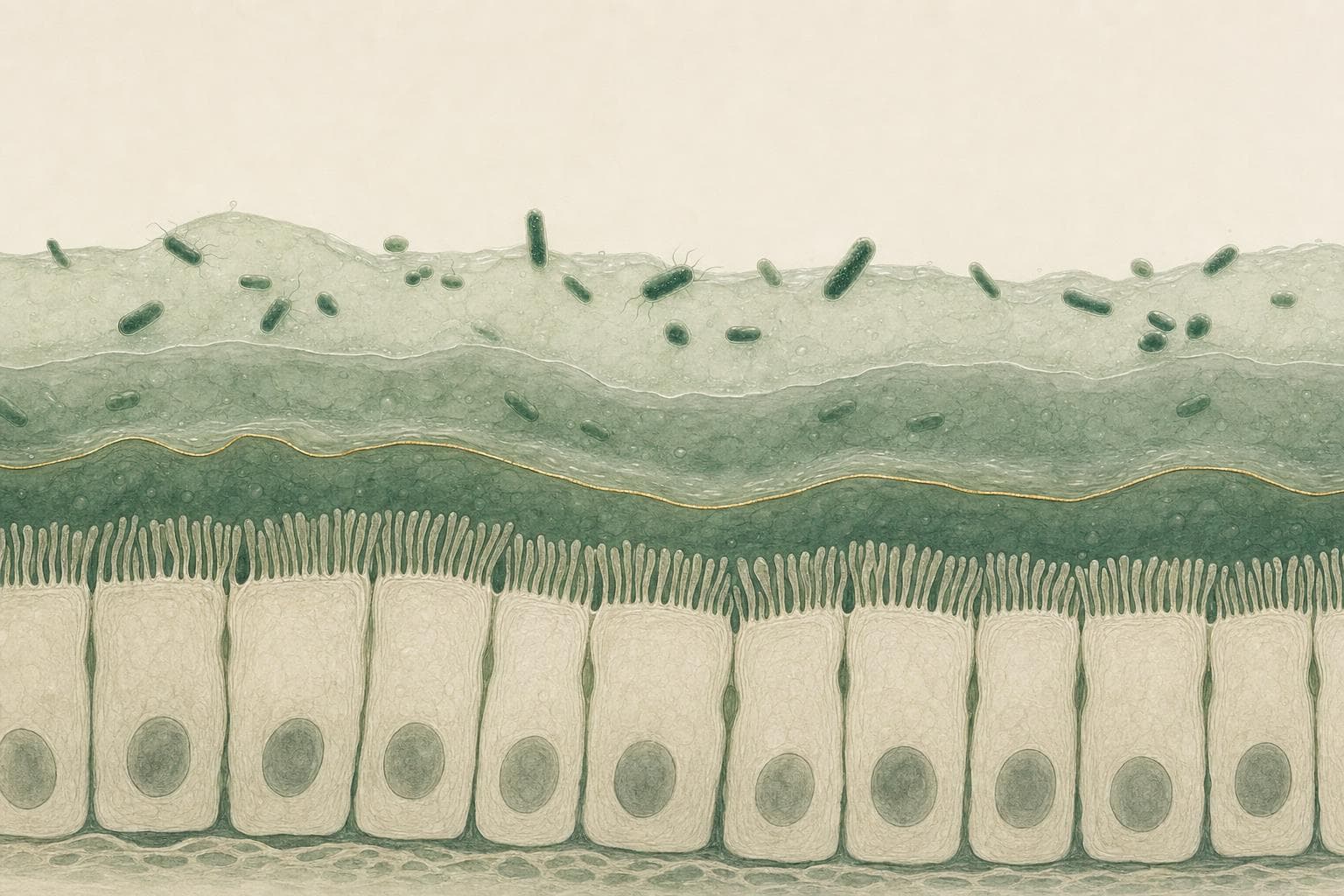
The mucin layer
Your gut wall is protected by two layers of mucus. Akkermansia lives in the outer one and grazes on mucin, which signals the cells of the gut wall to produce more. A well-maintained mucus layer is associated with a stronger gut barrier, and that single relationship runs through most of the research below.
Three pillars
Metabolic
Insulin sensitivity, the GLP-1 pathway, and the polyphenol–microbiome link. Anchors our Bilberry pairing.
Longevity
Pomegranate, urolithin A, and mitochondrial health. Anchors our Pomegranate pairing.
Gut
The mucin layer, the gut barrier, and microbial diversity. Anchors our Raspberry pairing.
Environment
The conditions Akkermansia lives in: the mucus layer it feeds on, dietary fibre, and the short-chain fatty acids the gut community trades. Anchors our Chicory Inulin and Microbiome Complex.
The evidence
Landmark studies, with the model and the source. Most of this research is in cells and animals; the human evidence is real but still early. We describe what each study found. We do not promise you the same result.
| Finding | Model | Source |
|---|---|---|
| Mechanism Discovery and naming of Akkermansia muciniphila as a mucin-degrading bacterium of the human gut. | review | Derrien M et al. Int J Syst Evol Microbiol 2004. DOI · PubMed |
| Metabolic Identified a cross-talk between Akkermansia and the gut lining that influences diet-induced obesity in mice. | mouse | Everard A et al. PNAS 2013. DOI · PubMed |
| Metabolic Cranberry polyphenols increased Akkermansia abundance and improved metabolic markers in mice — a clean berry-polyphenol → Akkermansia chain. | mouse | Anhê FF et al. Gut 2015. DOI · PubMed |
| Longevity Urolithin A induced mitophagy and prolonged lifespan in C. elegans, and improved muscle function in rodents. | C. elegans / rodent | Ryu D et al. Nat Med 2016. DOI · PubMed |
| Mechanism A purified surface protein — and the pasteurised bacterium — reproduced metabolic effects in obese and diabetic mice. | mouse | Plovier H et al. Nat Med 2017. DOI · PubMed |
| Longevity Pomegranate ellagitannins stimulated the growth of Akkermansia muciniphila in vivo (mice). | mouse | Henning SM et al. Anaerobe 2017. DOI · PubMed |
| Metabolic Blueberry supplementation influenced gut microbiota, inflammation and insulin resistance in a human study. | human study | Lee S et al. J Nutr 2018. DOI · PubMed |
| Longevity First human trial of urolithin A: safe, with a molecular signature of improved mitochondrial and cellular health (n=60). | human RCT | Andreux PA et al. Nat Metab 2019. DOI · PubMed |
| Gut Urolithin A supported gut-barrier integrity via the Nrf2 pathway. | in vitro / mouse | Singh R et al. Nat Commun 2019. DOI · PubMed |
| Metabolic First human trial of Akkermansia: the pasteurised form was safe and associated with improved metabolic markers over three months (n=32). | human RCT | Depommier C et al. Nat Med 2019. DOI · PubMed |
| Metabolic Identified P9, a protein Akkermansia secretes that triggers GLP-1 release from gut L-cells via the ICAM-2 receptor (mouse). | in vitro / mouse | Yoon HS et al. Nat Microbiol 2021. DOI · PubMed |
| Mechanism Comprehensive review positioning Akkermansia as a paradigm next-generation beneficial microbe. | review | Cani PD et al. Nat Rev Gastroenterol Hepatol 2022. DOI · PubMed |
| Longevity Randomised trial: urolithin A improved muscle endurance and mitochondrial biomarkers in middle-aged adults (n=88). | human RCT | Singh A et al. Cell Rep Med 2022. DOI · PubMed |
| Longevity Systematic review of the growing human evidence base for urolithin A. | review | Kuerec AH et al. Ageing Res Rev 2024. DOI · PubMed |
| Mechanism 2025 Nature Reviews Microbiology review of Akkermansia biology, ecology and therapeutic potential. | review | Ioannou A et al. Nat Rev Microbiol 2025. DOI · PubMed |
| Environment In gnotobiotic mice, depriving the diet of fibre pushed gut bacteria to feed on the colonic mucus layer instead, eroding the barrier and increasing susceptibility to an enteric pathogen. | mouse | Desai MS et al. Cell 2016. DOI · PubMed |
| Environment Six oligosaccharides tested against 31 gut anaerobes: Akkermansia muciniphila did not grow significantly on any of them. Prebiotic fibre cannot feed it directly. | in vitro / mouse | Ose R et al. Anaerobe 2018. DOI · PubMed |
| Environment In people with obesity, the levels of Anaerostipes, Akkermansia and Butyricicoccus BEFORE the intervention drove the drop in BMI on inulin. Akkermansia predicted who responded; it was not what inulin grew. | human RCT | Rodriguez J et al. Gut 2020. DOI · PubMed |
| Environment Inulin-type fructans in 30 women with obesity selectively shifted the microbiota, raising Bifidobacterium and Faecalibacterium prausnitzii, with modest metabolic change. Akkermansia was not among the reported responders. | human RCT | Dewulf EM et al. Gut 2013. DOI · PubMed |
| Environment Prebiotic fibre changed gut microbial composition and glucose and lipid handling in two mouse models of obesity. | mouse | Everard A et al. Diabetes 2011. DOI · PubMed |
| Metabolic 12-week RCT of a live strain in 58 people with type 2 diabetes: no significant difference from placebo on weight or HbA1c. A subgroup starting with low Akkermansia did improve — a hypothesis, not a result. | human RCT | Zhang Y et al. Cell Metab 2025. DOI · PubMed |
| Environment Concord grape polyphenols dramatically increased Akkermansia muciniphila and attenuated high-fat-diet metabolic syndrome in mice — the grape half of the polyphenol → Akkermansia chain. | mouse | Roopchand DE et al. Diabetes 2015. DOI · PubMed |
| Environment An oat diet lowered LDL cholesterol versus rice in mildly hypercholesterolemic adults, with a parallel rise in Akkermansia and Roseburia — human beta-glucan data with the microbiome measured. | human RCT | Xu D et al. Front Immunol 2021. DOI · PubMed |
| Environment Double-blind crossover trial at exactly 12 g/day chicory inulin: increased bowel-movement frequency and constipation-related quality of life, and enriched butyrate producers. | human RCT | Puhlmann ML et al. BMC Gastroenterol 2025. DOI · PubMed |
| Environment Meta-analysis across human trials: GOS reliably raises Akkermansia; inulin and polyphenols are inconsistent. The honesty anchor for everything we say about feeding the bacterium. | review | Tian B et al. Food Funct 2024. DOI · PubMed |
The human evidence: what the Akkermansia trials actually show
Four human studies of Akkermansia muciniphila have been published. An observational study in 2016, a 32-person proof-of-concept trial in 2019, a trial in people with type 2 diabetes in 2025, and a 90-person controlled trial of the pasteurised form in May 2026. Almost everything else written about this bacterium comes from mice or from mechanism work in cells. That work matters, and it is not the same thing as evidence in people. This page takes the four human studies in the order they happened and says what each one establishes and where each one stops.
2016 — an observation, not an intervention
The first human signal wasn't a supplement at all. Maria Carlota Dao and colleagues followed 49 overweight adults through a calorie-restricted diet and noticed that those who started with more Akkermansia in their gut tended to show better metabolic markers, including insulin sensitivity, lipids and inflammation, than those who started low (Dao et al., 2016, Gut).
This is an association. It tells us that Akkermansia abundance travels alongside better metabolism. It cannot tell us which causes which, or whether adding Akkermansia would change anything. The study poses the question; it does not answer it.
2019 — the first time anyone gave it to people
Clara Depommier and colleagues in Belgium ran the first interventional trial: 32 overweight, insulin-resistant adults took live A. muciniphila, the pasteurised form, or placebo, daily for three months (Depommier et al., 2019, Nature Medicine). The primary endpoint was safety, and both forms cleared it. The surprise was that the pasteurised, non-living form moved the metabolic markers most, which is the pasteurised paradox we cover separately.
The authors called it small and exploratory, and so do we. Thirty-two people, three months. That is a door opening onto a question. It is also the study that underpinned the EU's authorisation of pasteurised A. muciniphila as a Novel Food in 2022.
2025 — into a clinical population
The field had been waiting for something larger and more specific. In 2025 a trial in Cell Metabolism delivered it: instead of broadly overweight volunteers, it enrolled 58 people with overweight or obesity and type 2 diabetes, a population whose metabolism is by definition already disrupted, and gave half of them a live strain, AKK-WST01, for twelve weeks alongside routine lifestyle guidance (Zhang et al., 2025). That makes it a harder test and a more relevant one.
It missed. Both groups lost weight and both saw HbA1c fall, with no significant difference between them. The result that made the paper interesting came from splitting participants by how much Akkermansia they already carried: those starting low showed good colonisation and significant reductions in weight, fat mass and HbA1c; those starting high showed poor colonisation and no clinical benefit. The authors reproduced the pattern in germ-free mice and framed it as a hypothesis, which is what it is.
Two things follow, and both cut against the easy reading. A subgroup finding in a trial of 58 is hypothesis-generating, not evidence — it tells you what to test next. And the strain was live, where the form authorised in the EU and used in Vekovia is pasteurised; findings about one do not transfer to the other. A trial conducted in people with a condition is not permission to claim a supplement treats that condition. We keep those two ideas apart on purpose.
2026 — the newest trial, and the harder question
In May 2026, Nature Medicine published the study that closes the gap the others left open. Ninety adults with overweight or obesity first lost weight on an eight-week diet, then spent six months eating normally while taking either pasteurised A. muciniphila MucT or placebo (Mount et al., 2026). The supplemented group regained noticeably less: about 1.2 kg versus 3.2 kg over the maintenance period.
This one is easy to oversell, so it is worth reading precisely.
- It tested the harder problem: keeping weight off after a diet, which is where most people actually struggle.
- It used the same pasteurised form the earlier trials and the EU authorisation are built on.
- The effect was real and modest, a difference of roughly 2 kg, in a short trial with a carefully selected group of 90 people.
- It was funded by the company that develops the strain, the same European supplier our bacterium comes from. We tell you that because you should weigh it, and because the independent specialists who reviewed the trial said the honest thing: it is a proof of concept, not a reason to change anyone's medical care, and not an alternative to GLP-1 medicines like semaglutide.
The fair sentence is this. The first controlled trial to test the pasteurised form for weight-loss maintenance found a modest benefit, and the field's own independent commentators called it promising and preliminary in the same breath.
Why the mechanism work sits underneath all of this
None of these human trials float free of biology. Researchers keep testing Akkermansia in metabolic settings because there is a mechanism to test: in 2021, Yoon and colleagues showed that the bacterium secretes a protein, P9, which binds a receptor on intestinal cells and prompts them to release GLP-1, the gut's own appetite-and-glucose hormone (Yoon et al., 2021, Nature Microbiology). That work is mostly in mice. It is also the reason the human metabolic trials exist at all. We unpack it in the GLP-1 explainer.
What the four studies add up to
An observation (2016), a proof of concept (2019), a trial in a clinical population that missed its primary endpoint (2025), a controlled maintenance trial (2026). Each asks more of the bacterium than the one before it, and the record is genuinely mixed rather than a clean upward line — the 2025 trial did not work, and we would rather say so than leave it out. Four studies, none of them large, one of them negative, on an organism the research community itself still describes as a candidate rather than a settled tool.
Pasteurised Akkermansia muciniphila anchors Vekovia · Bilberry, our metabolic-leaning pairing: the bacterium alongside freeze-dried European bilberries, whose polyphenols the broader literature connects to it. We pair them because the science links them, and we describe that science rather than promise you what it will do.
References
[^DAO-2016]: Dao MC et al. Akkermansia muciniphila and improved metabolic health during a dietary intervention in obesity. Gut 2016. PMID 26100928. DOI 10.1136/gutjnl-2014-308778.
[^DEPOMMIER-2019]: Depommier C et al. Supplementation with Akkermansia muciniphila in overweight and obese human volunteers: a proof-of-concept exploratory study. Nature Medicine 2019. PMID 31263284. DOI 10.1038/s41591-019-0495-2.
[^ZHANG-2025]: Zhang Y et al. Akkermansia muciniphila supplementation in patients with overweight/obese type 2 diabetes. Cell Metabolism 2025. PMID 39879980. DOI 10.1016/j.cmet.2024.12.010.
[^MOUNT-2026]: Mount S et al. Pasteurized Akkermansia muciniphila MucT for weight loss maintenance in people with overweight and obesity: a controlled randomized trial. Nature Medicine 2026. PMID 42120725. DOI 10.1038/s41591-026-04394-7. Funded by The Akkermansia Company.
[^YOON-2021]: Yoon HS et al. Akkermansia muciniphila secretes a glucagon-like peptide-1-inducing protein that improves glucose homeostasis and ameliorates metabolic disease in mice. Nature Microbiology 2021. PMID 33820962. DOI 10.1038/s41564-021-00880-5.
Source
- Dao MC et al. Akkermansia muciniphila and improved metabolic health during a dietary intervention in obesity. Gut 2016. PMID 26100928. DOI · PubMed
- Depommier C et al. Supplementation with Akkermansia muciniphila in overweight and obese human volunteers: a proof-of-concept exploratory study. Nat Med 2019. PMID 31263284. DOI · PubMed
- Zhang Y et al. Akkermansia muciniphila supplementation in patients with overweight/obese type 2 diabetes. Cell Metab 2025. PMID 39879980. DOI · PubMed
- Mount S et al. Pasteurized Akkermansia muciniphila MucT for weight loss maintenance in people with overweight and obesity: a controlled randomized trial. Nat Med 2026. PMID 42120725. DOI · PubMed
- Yoon HS et al. Akkermansia muciniphila secretes a glucagon-like peptide-1-inducing protein that improves glucose homeostasis and ameliorates metabolic disease in mice. Nat Microbiol 2021. PMID 33820962. DOI · PubMed
How we cite
We link every claim to a primary source you can open. We do not use “on-hold” botanical claims, and we make no claim that Vekovia treats, prevents or cures anything. When the science is preliminary, we say so.