Gut · 7 min read
The mucin layer: your gut's quiet workhorse
Vekovia · 27 May 2026
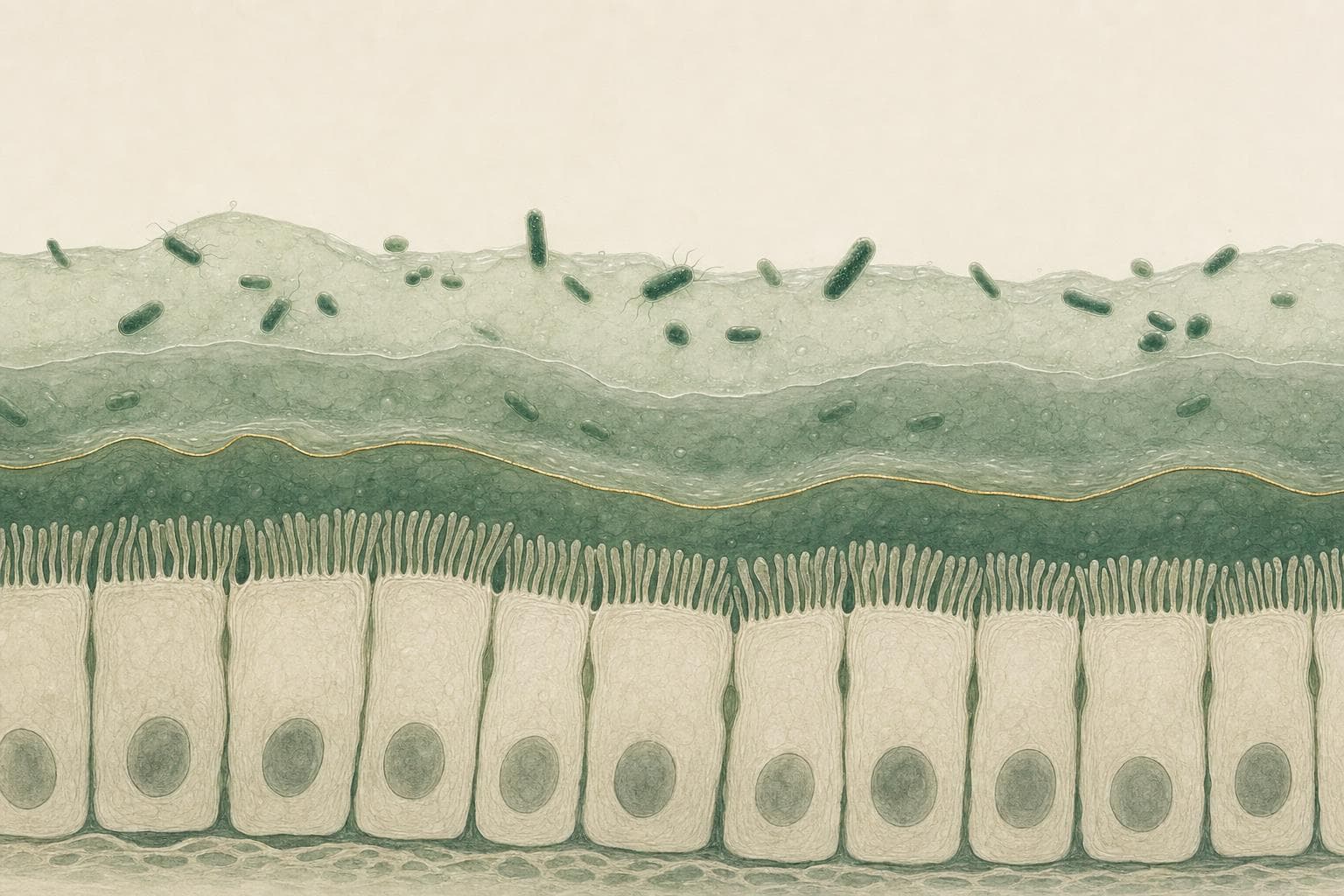
Most of what your gut does for you happens out of sight, and the part doing the quiet, unglamorous work is a layer of mucus. It never makes headlines. It is also one of the more important structures in the body: a soft, renewable barrier standing between the trillions of microbes in your gut and the cells underneath. Akkermansia muciniphila is one of the bacteria that lives in it, and helps maintain it.
Two layers, one job
Your intestinal wall is coated in mucus, and that mucus is not a single sheet. It is organised into two layers. The inner layer sits tight against the cells of the gut wall and is meant to stay relatively free of bacteria, a kept-clear zone. The outer layer is looser and more open, and it is where the resident microbes live and feed.
This arrangement is elegant. The outer layer gives bacteria a home and a food source; the inner layer keeps them at arm's length from the cells they could otherwise irritate. The barrier is built mostly from a large protein called mucin, secreted continuously by specialised goblet cells in the gut lining. "Continuously" is the key word: the layer is constantly being eaten away from the top and rebuilt from below. It is less a wall than a flowing river that happens to hold its shape.
Where Akkermansia comes in
Akkermansia muciniphila was first isolated and named in 2004 by Muriel Derrien and colleagues, who chose the species name muciniphila, "mucin-loving," because of a striking habit: it lives in the mucus layer and feeds on the mucin itself (Derrien et al., 2004). At first glance that sounds destructive. A bacterium that eats your gut lining?
The relationship turns out to be a cooperative one, and it shows up directly in the mucus. As Akkermansia grazes on the outer mucus, it produces signals and by-products that prompt your own goblet cells to make more mucin. The grazing encourages renewal. The two reviews that map this bacterium's biology, in Nature Reviews Gastroenterology & Hepatology (Cani et al., 2022) and Nature Reviews Microbiology (Ioannou et al., 2025), keep returning to this barrier relationship as the through-line of everything else Akkermansia is studied for.
Why a healthy barrier matters
Almost everything in this section comes from animal work, and it is worth saying so before we start.
The barrier's job is to keep the contents of your gut where they belong. The gut is full of bacteria, and bacterial cell walls carry a molecule called lipopolysaccharide, or LPS. While the mucus barrier is intact, LPS stays where it is. When the barrier thins or weakens, small amounts of LPS can leak across into the bloodstream, a phenomenon researchers call metabolic endotoxemia.
In plain terms: a leaky barrier lets bacterial fragments cross into circulation, where they trigger a low, simmering level of inflammation. You would not feel it as an illness. It is closer to a thermostat set slightly too high. Researchers connect this low-grade inflammation to a range of metabolic disturbances, which is why the integrity of the mucus barrier has become such a focus of study.
In a landmark 2013 study, Amandine Everard and colleagues showed in mice that Akkermansia sits at the centre of a "cross-talk" between the gut microbes and the intestinal lining, and that animals with more Akkermansia had a thicker mucus layer, a more intact barrier, and lower markers of this endotoxemia (Everard et al., 2013). Restoring the bacterium reversed some of the barrier damage caused by a high-fat diet.
What we will and won't say
We are careful here, because the mucin-layer story is easy to oversell. Most of the mechanistic evidence, including the barrier thickening, the endotoxemia and the cross-talk, comes from mice. The human picture is growing but still early. We describe what the studies found, with references, and we do not claim that any supplement repairs your gut, treats a condition, or fixes "leaky gut" as if it were a diagnosis. That is not what this research supports.
What can be said plainly is that the mucin layer is real, that it matters, and that Akkermansia muciniphila is one of the bacteria most consistently associated with maintaining it. That association is what Vekovia · Raspberry is built on, with a standardised raspberry polyphenol extract beside the pasteurised bacterium.
The next post covers how the bacterium is preserved for a capsule, and why the method came out of the same problem as feeding people in space.
References
- Derrien M et al. Akkermansia muciniphila gen. nov., sp. nov., a human intestinal mucin-degrading bacterium. Int J Syst Evol Microbiol 2004. PMID 15388697. DOI · PubMed
- Everard A et al. Cross-talk between Akkermansia muciniphila and intestinal epithelium controls diet-induced obesity. PNAS 2013. PMID 23671105. DOI · PubMed
- Cani PD et al. Akkermansia muciniphila: paradigm for next-generation beneficial microorganisms. Nat Rev Gastroenterol Hepatol 2022. PMID 35641786. DOI · PubMed
- Ioannou A et al. Akkermansia muciniphila: biology, microbial ecology, host interactions and therapeutic potential. Nat Rev Microbiol 2025. PMID 39406893. DOI · PubMed