Environment · 6 min read
What Akkermansia eats, and what happens when the food runs out
Vekovia · 6 August 2026
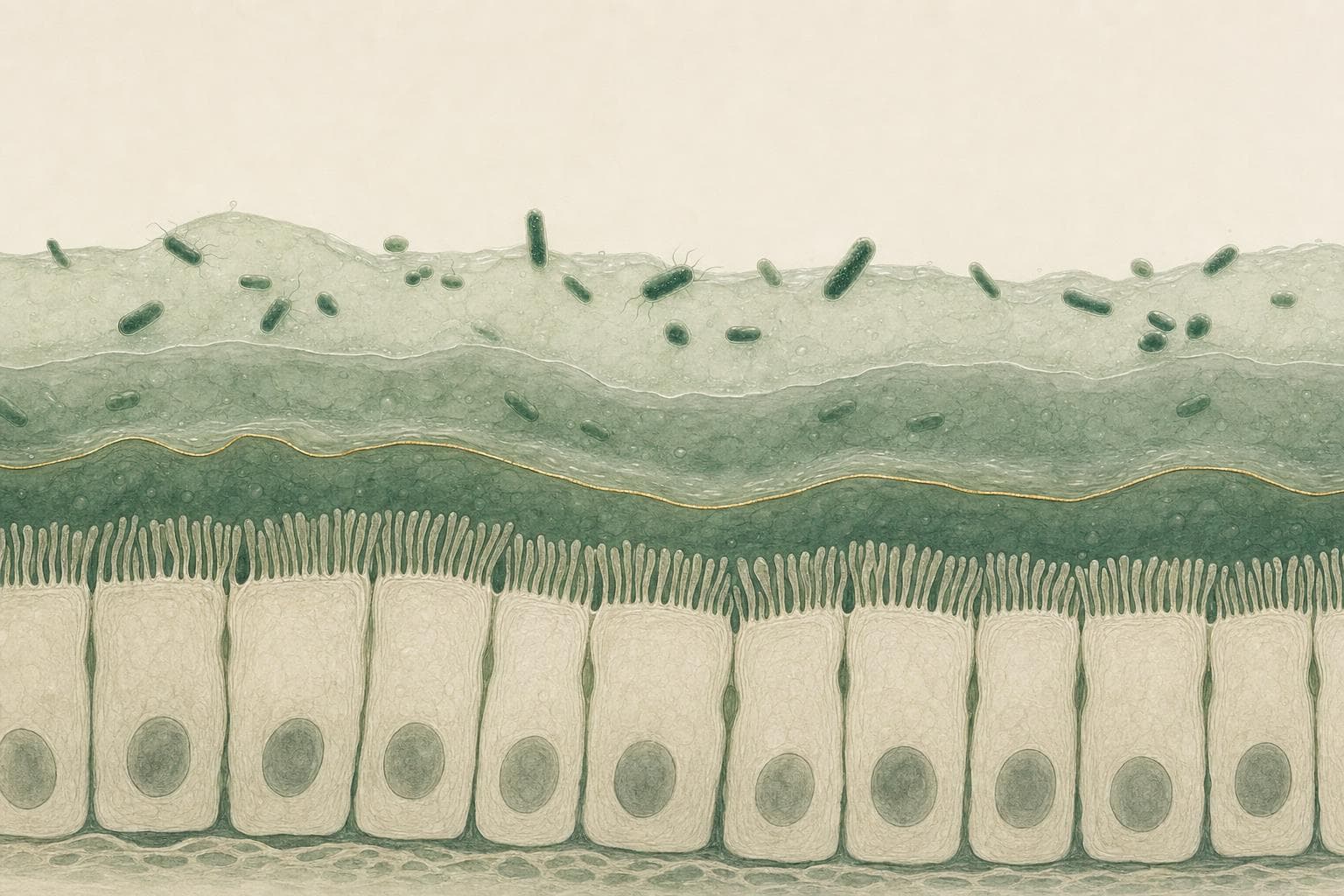
Most writing about gut bacteria treats them as passengers. You swallow one, it takes up residence, it does something useful. That framing skips the more interesting question, which is what the passenger finds when it gets there.
Akkermansia muciniphila is a good place to ask it, because its habitat and its dinner are the same thing.
A bacterium that eats the house
When Muriel Derrien and colleagues isolated the organism at Wageningen in 2004, they named it for the habit that made it unusual: it degrades mucin, the heavily sugar-coated protein that forms the gut's protective mucus lining (Derrien et al., 2004). Muciniphila means mucin-loving. It lives in the layer it consumes.
That sounds parasitic. Under normal conditions it is not. The mucus barrier is a two-layer structure, constantly secreted from below and constantly worn away from above, and the wearing away is part of how it stays healthy, because grazing prompts renewal. Akkermansia sits in the outer, looser layer, which is the layer meant to be lived in. The inner layer, the one pressed against the epithelium, is supposed to stay more or less sterile.
So the bacterium is not eating your gut wall. It is eating the outermost part of a coat your gut is continuously re-knitting.
The question that follows
If a bacterium eats mucin, what does it eat when there is plenty of other food? And what does the whole community eat when there isn't?
In 2016 Mahesh Desai and colleagues built an experiment that answers this cleanly enough to be worth reading twice (Desai et al., 2016). They took germ-free mice and colonised them with a synthetic community of fourteen fully sequenced human gut bacteria: a gut you can actually account for, rather than the usual unmapped thousands. Then they varied the fibre.
On a fibre-rich diet, the community ate the fibre.
On a fibre-deprived diet, the community turned on the mucus. Bacteria capable of degrading host glycans expanded and shifted their metabolism toward eating the mucus layer. The colonic mucus barrier eroded. And when the researchers then introduced Citrobacter rodentium, a mucosal pathogen, the fibre-deprived mice suffered markedly worse infection.
The paper's title states the finding without ornament: a dietary fibre-deprived gut microbiota degrades the colonic mucus barrier and enhances pathogen susceptibility.
What this does and does not show
It is a mouse study. It is a gnotobiotic mouse study, which means the gut community was assembled by the experimenters rather than grown up in a living animal. That is the source of its precision and also of its artificiality. Fourteen species is not a human microbiome.
What it establishes is a mechanism, and mechanisms travel better than effect sizes. The mechanism is this: mucin is a food source, and it is the food source the community falls back on. Whether your gut bacteria eat what you ate or eat your gut lining depends, in part, on whether you gave them anything else.
What it does not show is that eating more fibre thickens your mucus layer, or that any particular fibre does anything for any particular bacterium in a person. That is a different claim requiring different evidence, and we go through what the human trials actually found, including where they came up empty, in a separate post.
Why we keep returning to the layer
The mucus layer is the thread running through nearly all of the Akkermansia research. It is why the bacterium was named what it was named, it is the setting for most of the mechanistic work, and it is the reason the two major reviews of the field — including Cani and de Vos in Nature Reviews Gastroenterology & Hepatology — spend as much time on gut-barrier biology as on metabolism (Cani et al., 2022).
It is also the part of the story that gets left out of supplement marketing, because it points somewhere inconvenient: at the diet, not at the capsule.
We sell both. Three products that add the bacterium, and one that is just fibre. We are aware which of those two the evidence in people is stronger for, and it is not the interesting one.
References
- Derrien M et al. Akkermansia muciniphila gen. nov., sp. nov., a human intestinal mucin-degrading bacterium. Int J Syst Evol Microbiol 2004. PMID 15388697. DOI · PubMed
- Desai MS et al. A dietary fiber-deprived gut microbiota degrades the colonic mucus barrier and enhances pathogen susceptibility. Cell 2016. PMID 27863247. DOI · PubMed
- Cani PD et al. Akkermansia muciniphila: paradigm for next-generation beneficial microorganisms. Nat Rev Gastroenterol Hepatol 2022. PMID 35641786. DOI · PubMed