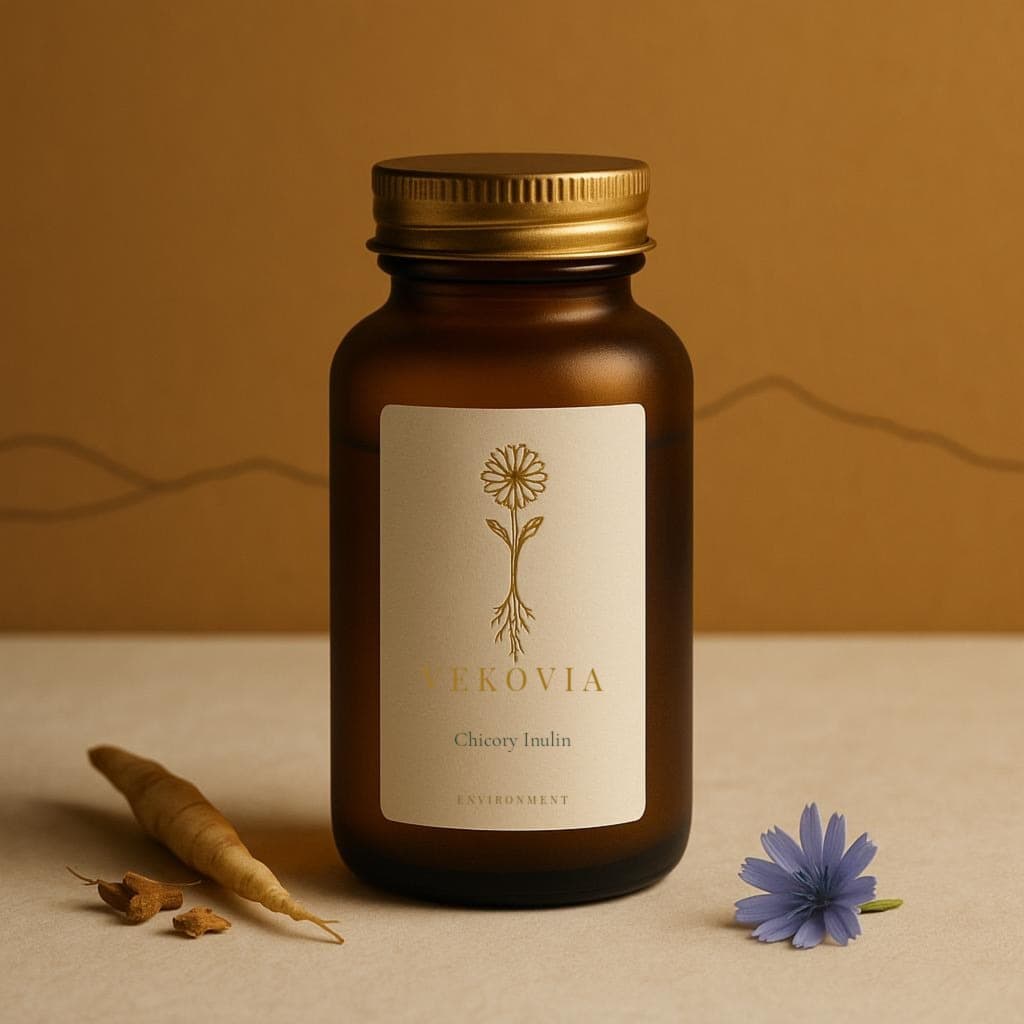
Vekovia · Chicory Inulin
Native chicory root inulin, 12 g a day. The fibre half of the range, and the only Vekovia that contains no Akkermansia.
Chicory inulin contributes to normal bowel function by increasing stool frequency.
The other half of the question. Not what you add — what you feed.
What it is
A single-ingredient powder, not a capsule. One 12 g scoop daily in water, coffee or food.
- Native chicory root inulin (Cichorium intybus), the unfractionated form: monosaccharides under 10%, plus disaccharides and inulin-type fructans with a degree of polymerisation of 9 or more. That specification matters: it is the exact form the EU authorisation covers.
- Nothing else. No filler, no sweetener, no flavouring.
- 12 g per day. The beneficial effect is obtained with a daily intake of 12 g chicory inulin.
Chicory inulin contributes to normal bowel function by increasing stool frequency.
Why this exists
The three fruit pairings add Akkermansia muciniphila to your gut. This one does not add anything living at all. It is here because a bacterium is not only what you swallow — it is also what it finds when it arrives.
A. muciniphila lives in the mucus layer of the colon and feeds on mucin, the protein that layer is built from (Derrien et al., 2004). That layer is not fixed. In a 2016 study in Cell, mice carrying a defined human gut community were fed a fibre-deprived diet; their bacteria switched to eating the host's own mucus, the barrier thinned, and the animals became markedly more vulnerable to an intestinal pathogen (Desai et al., 2016). Restoring fibre changed the behaviour.
That is a mouse study, and mice are not people. What it establishes is narrower than the internet usually reports: fibre availability is one of the things that determines whether the gut's bacteria eat what you ate or eat your gut lining.
Chicory inulin is one of the best-characterised fermentable fibres available, which is why it is the one we made.
What we are not claiming
This product will not raise your Akkermansia. As far as the evidence goes, it probably cannot.
When six oligosaccharides were tested one at a time against 31 gut anaerobes, Akkermansia muciniphila did not grow significantly on any of them (Ose et al., 2018). It eats mucin, not fibre. And in the trial that looked hardest, the Akkermansia someone already had before starting inulin predicted whether they responded to it — a starting condition, not a result (Rodriguez et al., 2020).
The honest state of it: prebiotic fibre reshapes the gut community in mice, including in models of obesity (Everard et al., 2011). In the clearest human test — a double-blind trial of inulin-type fructans in 30 women with obesity — the microbiota did shift selectively, but the bacteria that rose were Bifidobacterium and Faecalibacterium prausnitzii. Akkermansia was not among the reported responders (Dewulf et al., 2013).
So the claim on this label is about bowel function, because that is the claim the evidence supports and the only one the European Union has authorised. The Akkermansia connection is a reason we find the ingredient interesting, not a promise we are making about it. We would rather sell you a good fibre honestly than a mediocre story well.
More in the science hub, and the longer version in what Akkermansia actually eats.
How to take it
One 12 g scoop daily, stirred into water or any cold or warm drink, or into food. Introduce it gradually. Inulin is fermented in the colon, and going straight to a full dose can cause wind or bloating for the first few days. That settles.
Not suitable for children under 12, pregnant or breastfeeding women. A food supplement is not a substitute for a varied, balanced diet and a healthy lifestyle.
References
- Desai MS et al. A dietary fiber-deprived gut microbiota degrades the colonic mucus barrier and enhances pathogen susceptibility. Cell 2016. PMID 27863247. DOI · PubMed
- Ose R et al. The ability of human intestinal anaerobes to metabolize different oligosaccharides: a novel means for microbiota modulation?. Anaerobe 2018. PMID 29734011. DOI · PubMed
- Rodriguez J et al. Discovery of the gut microbial signature driving the efficacy of prebiotic intervention in obese patients. Gut 2020. PMID 32041744. DOI · PubMed
- Dewulf EM et al. Insight into the prebiotic concept: lessons from an exploratory, double blind intervention study with inulin-type fructans in obese women. Gut 2013. PMID 23135760. DOI · PubMed
- Everard A et al. Responses of gut microbiota and glucose and lipid metabolism to prebiotics in genetic obese and diet-induced leptin-resistant mice. Diabetes 2011. PMID 21933985. DOI · PubMed
- Derrien M et al. Akkermansia muciniphila gen. nov., sp. nov., a human intestinal mucin-degrading bacterium. Int J Syst Evol Microbiol 2004. PMID 15388697. DOI · PubMed