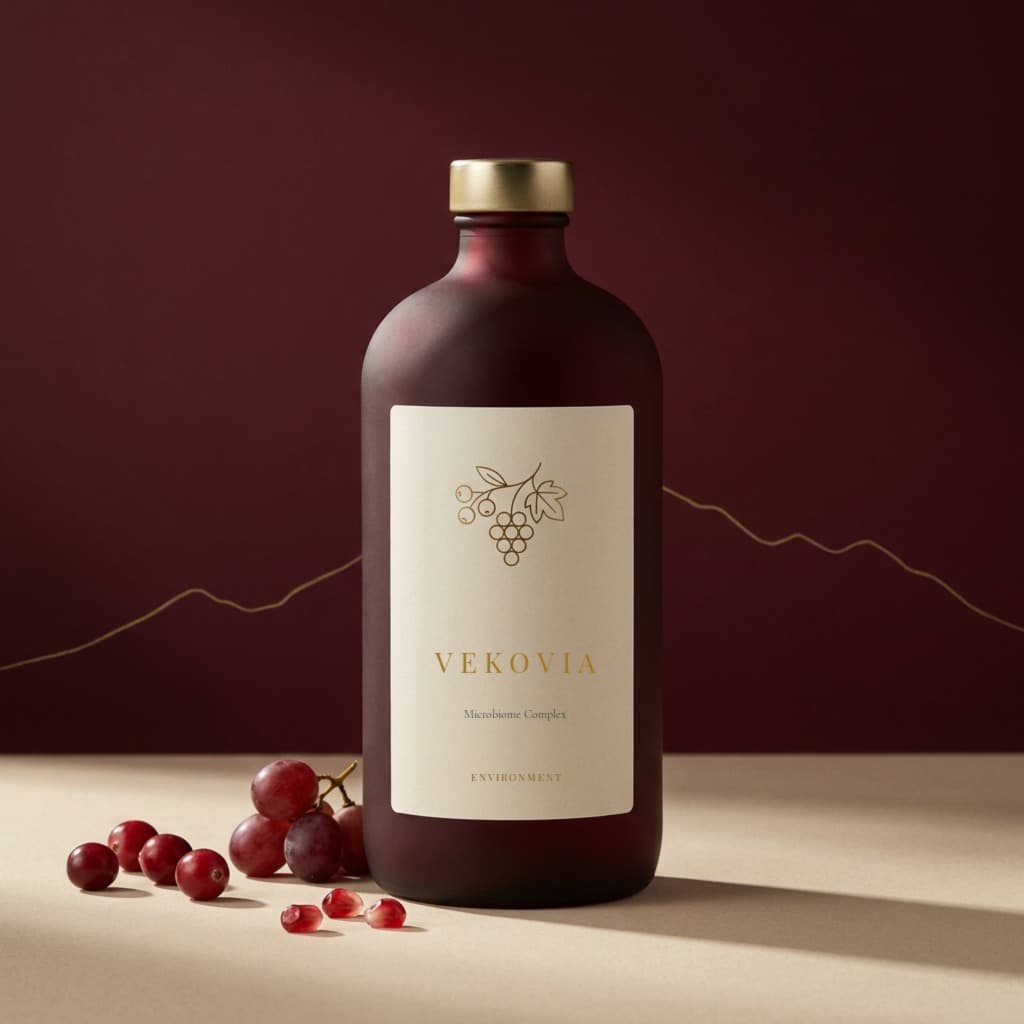
Vekovia · Microbiome Complex
Cranberry, pomegranate and grape-seed polyphenols with the fermentable fibre beta-glucan. Food for the bacteria you already have — no live strain.
Feed them, don't add them. The polyphenol half of the feed-your-bacteria range.
What it is
Four ingredients in a vegan capsule (HPMC), four capsules a day:
- Cranberry extract, standardised to 40% proanthocyanidins (PAC) — 400 mg
- Pomegranate extract, 40% ellagic acid — 300 mg
- Grape seed extract (oligomeric proanthocyanidins, OPC) — 200 mg
- Beta-glucan, a fermentable fibre — 1,430 mg
≈ 2,330 mg of active ingredients per daily dose. 120 capsules = a 30-day supply. Made in the EU. No live bacterium, no filler story about one.
Why this exists
Our three fruit pairings add pasteurised Akkermansia muciniphila to your gut. This product takes the opposite approach, and it is deliberate: it feeds the microbes you already carry.
The logic runs through the polyphenols. Most of them are poorly absorbed in the small intestine — which is usually listed as a flaw, but is exactly why they reach the colon, where your gut bacteria live. In mice, a polyphenol-rich cranberry extract increased Akkermansia abundance and improved metabolic markers (Anhê et al., 2015), and grape polyphenols did the same — the paper's own words are "dramatically increased" (Roopchand et al., 2015). In people, pomegranate extract raised faecal Akkermansia (Henning et al., 2017), and the volunteers who could convert its ellagitannins into urolithin A carried 33–47 times more of the bacterium than those who couldn't (Li et al., 2015). The fermentable fibre is there for the wider community: bacteria that ferment it produce short-chain fatty acids, and a fibre-starved community starts eating something else — the gut's own mucus layer (Desai et al., 2016). In a human trial, an oat diet rich in beta-glucan lowered LDL cholesterol alongside a rise in Akkermansia and Roseburia (Xu et al., 2021).
What we are not claiming
We cannot promise this raises your Akkermansia, and we won't. The strongest results above — cranberry and grape — are mouse studies. The human data are smaller and more mixed: in one of the most careful human trials, a year of daily cranberry in women with recurrent urinary-tract infections barely moved the gut microbiome (Straub et al., 2021); the strongest human cranberry signal is bifidogenic, not Akkermansia (Lessard-Lord et al., 2024); a grape-powder pilot that did raise Akkermansia had no placebo arm (Yang et al., 2021); and a three-week pomegranate trial moved short-chain fatty acids without moving a single blood marker (Hou et al., 2024). Fibre cannot feed Akkermansia directly either; it eats mucin, not fibre (Ose et al., 2018). What feeding the wider community does is indirect: cross-feeding, short-chain fatty acids, and a mucus layer that gets to stay food for the bacterium that lives on it (Derrien et al., 2004).
There is also no authorised EU health claim on this label. Beta-glucan's cholesterol claim requires 3 g a day from oats or barley; our dose is 1.43 g, so we do not use it. The polyphenol claims that circulate for cranberry, pomegranate and grape seed are "on hold" botanical claims, and we do not use those anywhere. This is a food supplement built on mechanism and animal evidence, sold to you as exactly that.
How to take it
Four capsules daily with water, with a meal — at once, or split 2 + 2 morning and evening. Start with two capsules a day for the first 3–5 days so the fibre doesn't announce itself as bloating. Drink water through the day. For best results take it consistently; a sensible cycle is 8–12 weeks.
Not suitable for children under 12, pregnant or breastfeeding women. A food supplement is not a substitute for a varied, balanced diet and a healthy lifestyle.
References
- Anhê FF et al. A polyphenol-rich cranberry extract protects from diet-induced obesity, insulin resistance and intestinal inflammation in association with increased Akkermansia spp.. Gut 2015. PMID 25080446. DOI · PubMed
- Roopchand DE et al. Dietary polyphenols promote growth of the gut bacterium Akkermansia muciniphila and attenuate high-fat diet-induced metabolic syndrome. Diabetes 2015. PMID 25845659. DOI · PubMed
- Henning SM et al. Pomegranate ellagitannins stimulate the growth of Akkermansia muciniphila in vivo. Anaerobe 2017. PMID 27940244. DOI · PubMed
- Li Z et al. Pomegranate extract induces ellagitannin metabolite formation and changes stool microbiota in healthy volunteers. Food Funct 2015. PMID 26189645. DOI · PubMed
- Lessard-Lord J et al. Short term supplementation with cranberry extract modulates gut microbiota in human and displays a bifidogenic effect. NPJ Biofilms Microbiomes 2024. PMID 38448452. DOI · PubMed
- Yang J et al. Effect of standardized grape powder consumption on the gut microbiome of healthy subjects: a pilot study. Nutrients 2021. PMID 34836220. DOI · PubMed
- Xu D et al. Oat consumption reduces LDL cholesterol and is associated with Akkermansia muciniphila and Roseburia in mildly hypercholesterolemic subjects: a randomized controlled trial. Front Immunol 2021. PMID 34956218. DOI · PubMed
- Hou C et al. Pomegranate juice supplemented with inulin modulates gut microbiota and increases microbiota-derived short-chain fatty acids in overweight and obese adults. J Agric Food Chem 2024. PMID 38887904. DOI · PubMed
- Straub TJ et al. Limited effects of long-term daily cranberry consumption on the gut microbiome in a placebo-controlled study of women with recurrent urinary tract infections. BMC Microbiol 2021. PMID 33596852. DOI · PubMed
- Desai MS et al. A dietary fiber-deprived gut microbiota degrades the colonic mucus barrier and enhances pathogen susceptibility. Cell 2016. PMID 27863247. DOI · PubMed
- Ose R et al. The ability of human intestinal anaerobes to metabolize different oligosaccharides: a novel means for microbiota modulation?. Anaerobe 2018. PMID 29734011. DOI · PubMed
- Derrien M et al. Akkermansia muciniphila gen. nov., sp. nov., a human intestinal mucin-degrading bacterium. Int J Syst Evol Microbiol 2004. PMID 15388697. DOI · PubMed