Metabolic · 5 min read
Bilberry: the metabolic berry
Vekovia · 27 May 2026
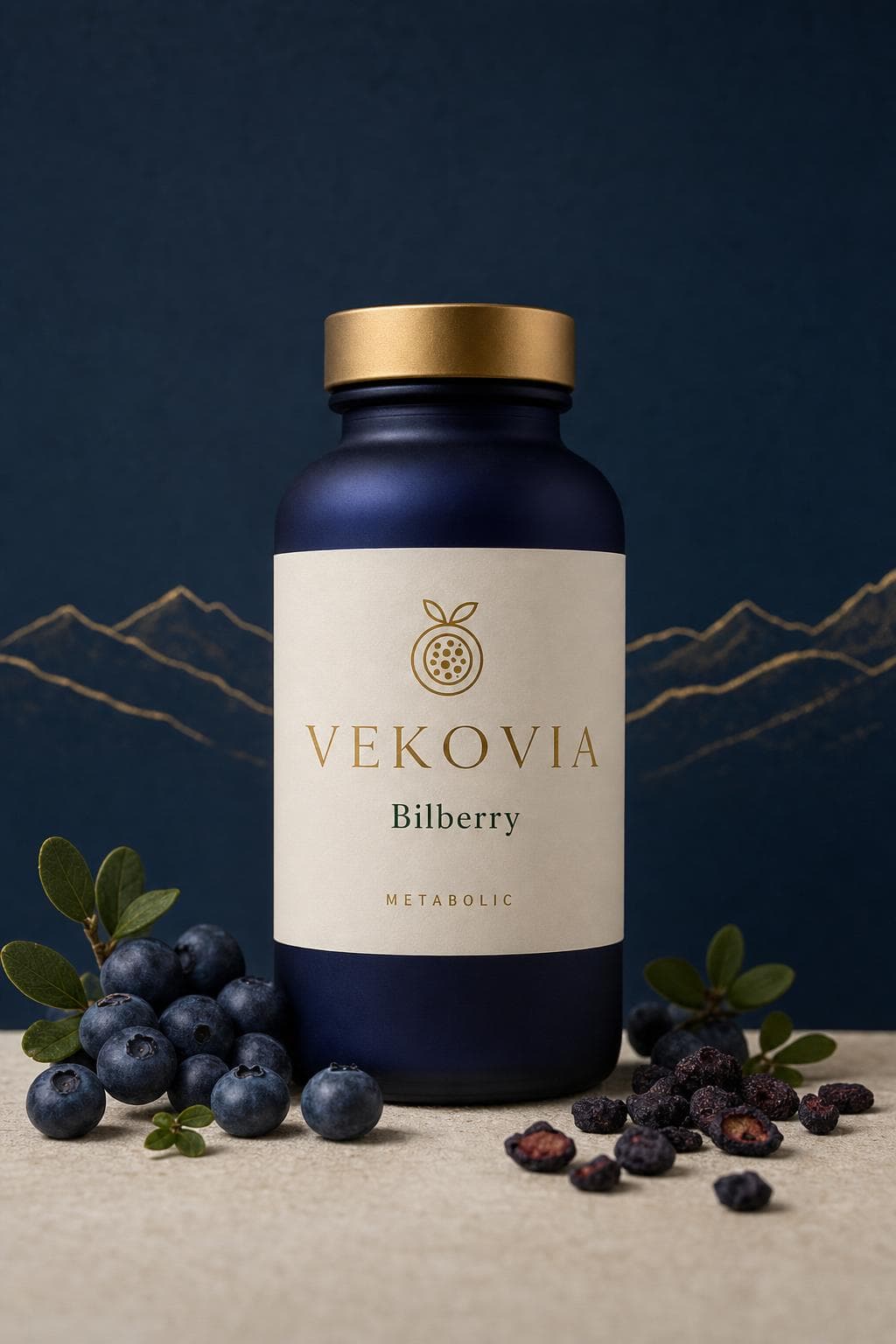
When people hear "blueberry" they picture the big, pale-fleshed cultivated berries on supermarket shelves. The European bilberry (Vaccinium myrtillus) is a different plant. It is smaller, dark all the way through rather than white inside, and it grows wild across the forests and heaths of northern Europe. It also carries two to four times the anthocyanin content of its cultivated cousin. That density is why it is the berry in Vekovia · Bilberry.
Why a berry at all?
Akkermansia doesn't live in a vacuum. It thrives in a gut environment shaped by what you eat, and one of the clearest signals in the literature is that berry-type polyphenols are associated with more Akkermansia. The cleanest demonstration came from a cranberry study where polyphenol-rich extract increased Akkermansia abundance alongside improved metabolic markers in mice (Anhê et al., 2015). Blueberry polyphenols have been studied along similar lines in humans, influencing the gut microbiota and markers of insulin sensitivity (Lee et al., 2018).
The pairing follows from that. Feed the environment the bacterium prefers, and put the bacterium in beside it.
Why bilberry specifically
Three reasons, in order of weight:
- Anthocyanin density. More polyphenol per gram than cultivated blueberry, and the polyphenol fraction is what the research is actually about.
- European provenance. The bacterium comes from a Belgian lab and the berry from European growers, which keeps the whole chain on one continent.
- A metabolic-health literature that maps onto our metabolic angle, alongside the human Akkermansia trial (Depommier et al., 2019) and the mechanism connecting the bacterium to GLP-1 release (Yoon et al., 2021).
Vekovia · Bilberry is built on those three, in that order.
What we're careful not to say
We are not telling you that Vekovia · Bilberry lowers your blood sugar, improves your insulin sensitivity, or treats anything (the discipline behind the whole brand). What we can say honestly sits on the label: the small dose of chromium in each capsule contributes to the maintenance of normal blood glucose levels, an authorised EU claim for that nutrient.
Everything else here is research, described and referenced, and left where the researchers left it.
There is also an unscientific test. Crush a bilberry and it stains your fingers dark purple all the way through; a cultivated blueberry leaves them clean. That is the anthocyanin difference, visible without a laboratory.
References
- Anhê FF et al. A polyphenol-rich cranberry extract protects from diet-induced obesity, insulin resistance and intestinal inflammation in association with increased Akkermansia spp.. Gut 2015. PMID 25080446. DOI · PubMed
- Lee S et al. Blueberry supplementation influences the gut microbiota, inflammation, and insulin resistance. J Nutr 2018. PMID 29490092. DOI · PubMed
- Depommier C et al. Supplementation with Akkermansia muciniphila in overweight and obese human volunteers: a proof-of-concept exploratory study. Nat Med 2019. PMID 31263284. DOI · PubMed
- Yoon HS et al. Akkermansia muciniphila secretes a glucagon-like peptide-1-inducing protein that improves glucose homeostasis and ameliorates metabolic disease in mice. Nat Microbiol 2021. PMID 33820962. DOI · PubMed