Environment · 6 min read
Cranberry, the A-type berry: what the polyphenol actually does in a gut
Vekovia · 13 September 2026
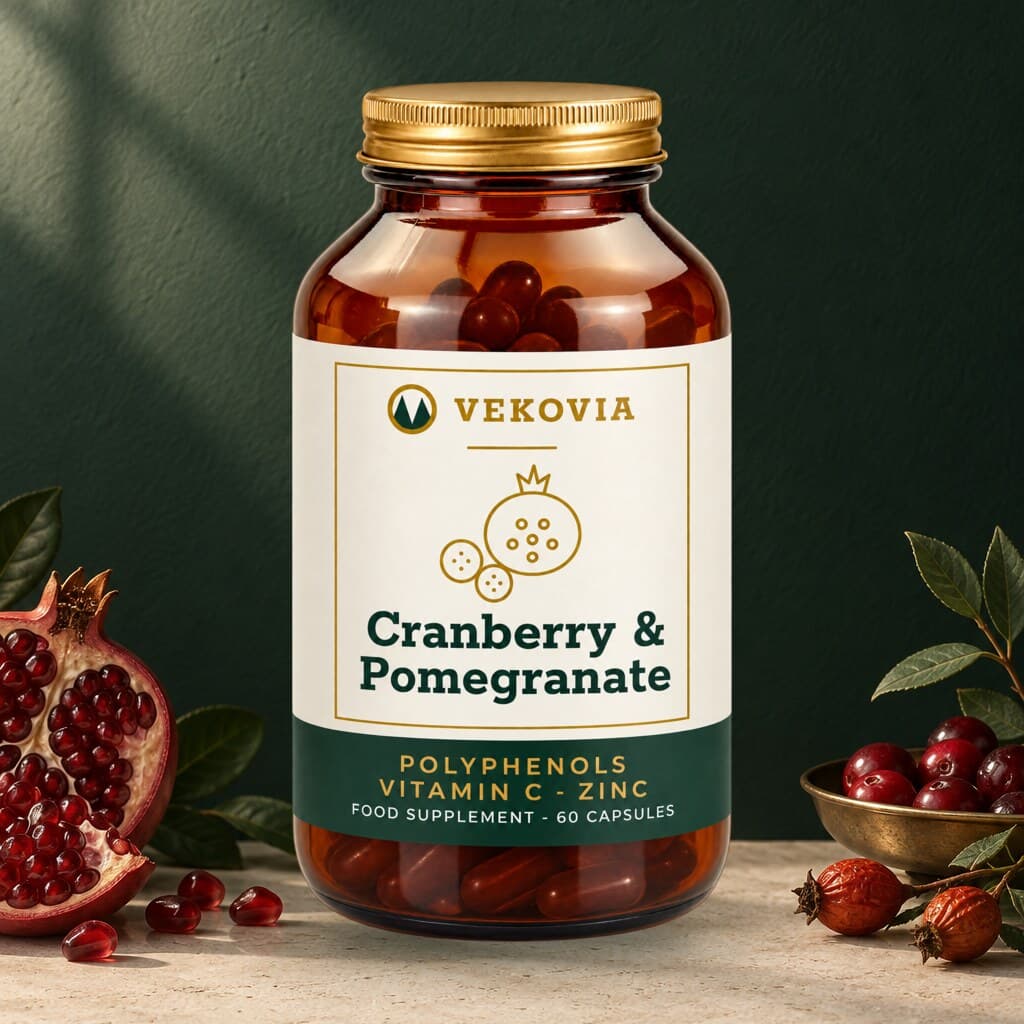
Cranberry is in three of our four formulas, and the reason is a single class of molecule: the A-type proanthocyanidin. Most plants build their proanthocyanidins with one kind of bond between the units. Cranberry, almost uniquely among common foods, builds a share of them with a second bond as well — the A-type — which makes the molecule larger, stiffer and harder for anything to take apart. That awkwardness is the whole story.
Poorly absorbed, which is the point
A polyphenol that is absorbed in the small intestine goes into the bloodstream and never meets the colon. A polyphenol that is not absorbed carries on down the gut and arrives, more or less intact, where the microbiota lives. Cranberry proanthocyanidins are in the second group. Only a small fraction is absorbed, and the rest reaches the colon.
What happens to them there is unusual. In 2024 a Canadian group ran faecal fermentations from 34 donors and then a four-day human supplementation, and found that less than 1% of cranberry's flavan-3-ols were broken down into the small phenolic metabolites the gut normally makes from plant polyphenols (Lessard-Lord et al., 2024, Molecular Nutrition & Food Research). The molecules were not being eaten. Whatever they do, they do as themselves — by interacting with bacteria and with the gut wall, rather than by being converted into something else.
The mouse study everyone cites
The paper that made cranberry a microbiome ingredient is Anhê and colleagues' 2015 study in Gut (Anhê et al., 2015). Mice on a high-fat, high-sugar diet were given a polyphenol-rich cranberry extract for eight weeks. They gained less weight, handled glucose better, showed less intestinal inflammation — and the proportion of Akkermansia in their gut rose markedly, in the authors' words. It is the cleanest berry-polyphenol → Akkermansia chain in the literature.
It is also a mouse study. We say so every time we cite it, because the human data that followed do not repeat it in the same shape.
What happened in people
Three human studies are worth reading side by side.
In 2018, healthy volunteers ate sweetened dried cranberries for two weeks; the faecal microbiome shifted and Akkermansia rose in most — not all — subjects. Small, uncontrolled, no placebo (Bekiares et al., 2018).
In 2021, the most careful trial of the lot gave women with recurrent urinary-tract infections a daily cranberry beverage for a year, against placebo, and sequenced their stool. The gut microbiome barely moved (Straub et al., 2021). A year of cranberry, and the community stayed roughly where it was.
In 2024, a four-day supplementation with a cranberry extract rich in proanthocyanidins and oligosaccharides produced a clear and rapid response — but the organisms that rose were Bifidobacterium and the butyrate producers, and the short-chain fatty acid profile shifted toward butyrate (Lessard-Lord et al., 2024, npj Biofilms and Microbiomes). The strongest human cranberry signal, in other words, is bifidogenic, not Akkermansia.
A 2024 meta-analysis across human prebiotic trials puts the same conclusion in one line: polyphenols' effect on Akkermansia abundance in people is inconsistent (Tian et al., 2024).
What we take from that
Two things, and they point in different directions, which is why both are on this page.
The first is that cranberry proanthocyanidins genuinely reach the colon and genuinely change what lives there, in mice and in people, within days. That is a real property of a real ingredient, and it is why 400–500 mg of a 40%-standardised extract sits in Microbiome Complex, Cranberry & Pomegranate and both powders.
The second is that "raises your Akkermansia" is a mouse sentence. In people, the response is smaller, it varies from one person to the next, and the bacteria that respond most reliably are others. We do not print the mouse sentence on a label, and we would rather you heard the human version from us than from a competitor's asterisk.
Cranberry is on the ingredient list because of what it does in a gut, described accurately. That is the only reason anything is on our ingredient lists.
References
- Anhê FF et al. A polyphenol-rich cranberry extract protects from diet-induced obesity, insulin resistance and intestinal inflammation in association with increased Akkermansia spp.. Gut 2015. PMID 25080446. DOI · PubMed
- Lessard-Lord J et al. Short term supplementation with cranberry extract modulates gut microbiota in human and displays a bifidogenic effect. NPJ Biofilms Microbiomes 2024. PMID 38448452. DOI · PubMed
- Lessard-Lord J et al. Assessing the gut microbiota's ability to metabolize oligomeric and polymeric flavan-3-ols from aronia and cranberry. Mol Nutr Food Res 2024. PMID 38350729. DOI · PubMed
- Straub TJ et al. Limited effects of long-term daily cranberry consumption on the gut microbiome in a placebo-controlled study of women with recurrent urinary tract infections. BMC Microbiol 2021. PMID 33596852. DOI · PubMed
- Bekiares N et al. Effect of sweetened dried cranberry consumption on urinary proteome and fecal microbiome in healthy human subjects. OMICS 2018. PMID 28618237. DOI · PubMed
- Tian B et al. Effects of prebiotics on Akkermansia muciniphila abundance in humans: a systematic review and meta-analysis. Food Funct 2024. PMID 38590256. DOI · PubMed