Longevity · 6 min read
The pomegranate trail: from a Mediterranean fruit to a mitochondrial molecule
Vekovia · 27 May 2026
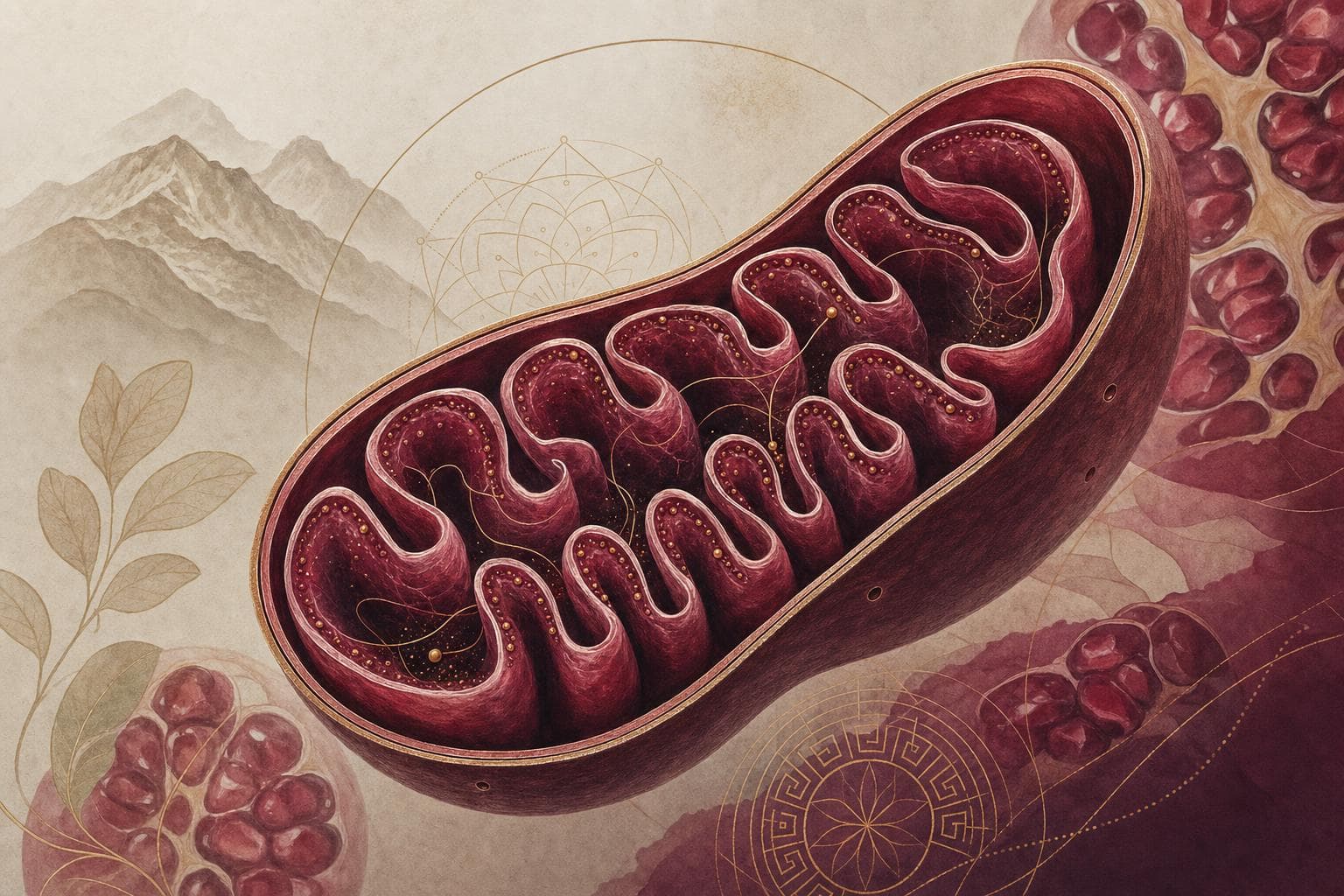
Most ingredients sold under the word "longevity" arrive with a story and no chain of custody. Pomegranate comes with one. You can follow it from the fruit, through a named gut bacterium, to a molecule that has been given to people under trial conditions.
Step one: the fruit feeds the bacterium
Pomegranate is rich in ellagitannins, large polyphenols of which punicalagin is the best known. In a 2017 study, pomegranate ellagitannins stimulated the growth of Akkermansia muciniphila in vivo (Henning et al., 2017). Fruit and bacterium are joined in the literature directly, not by association alone.
What the gut does with the rest
The chemistry then passes to the microbes. They metabolise those same ellagitannins into urolithin A, a compound the human body cannot assemble without the right microbial community doing the work first. Urolithin A is among the more closely studied small molecules in mitochondrial biology:
- It induced mitophagy (the cell's recycling of worn-out mitochondria) and extended lifespan in C. elegans, and improved muscle function in rodents (Ryu et al., 2016).
- In a first-in-human trial it was safe and produced a molecular signature of improved mitochondrial and cellular health (Andreux et al., 2019).
- In a randomised trial in middle-aged adults, it improved muscle endurance and mitochondrial biomarkers (Singh et al., 2022).
- A 2024 systematic review summarised the human evidence to date (Kuerec et al., 2024).
There is a gut angle as well. Urolithin A has been shown to support gut-barrier integrity via the Nrf2 pathway (Singh et al., 2019), which is the same barrier Akkermansia helps maintain.
The chain, in one line
Pomegranate ellagitannins → more Akkermansia + the substrate for urolithin A → mitochondrial and barrier effects measured in people. Pairing pasteurised Akkermansia with pomegranate puts both ends of that chain in one capsule. Vekovia · Pomegranate is that capsule. That is the reasoning behind the pairing, and it stops there.
The honest part
Most of the lifespan and mitophagy work is in cells and animals. The human urolithin A trials are real and tightly scoped, built around specific biomarkers and muscle endpoints rather than "longevity" as an outcome. We make no claim that Vekovia extends life or reverses aging. On the label, the small dose of vitamin C carries its authorised claim: it contributes to the protection of cells from oxidative stress.
Even a well-mapped chain has a loose end. How much urolithin A a given person's microbes produce from the same fruit varies widely, and no capsule settles that question in advance.
References
- Henning SM et al. Pomegranate ellagitannins stimulate the growth of Akkermansia muciniphila in vivo. Anaerobe 2017. PMID 27940244. DOI · PubMed
- Ryu D et al. Urolithin A induces mitophagy and prolongs lifespan in C. elegans and increases muscle function in rodents. Nat Med 2016. PMID 27400265. DOI · PubMed
- Andreux PA et al. The mitophagy activator urolithin A is safe and induces a molecular signature of improved mitochondrial and cellular health in humans. Nat Metab 2019. PMID 32694802. DOI · PubMed
- Singh A et al. Urolithin A improves muscle strength, exercise performance, and biomarkers of mitochondrial health in a randomized trial in middle-aged adults. Cell Rep Med 2022. PMID 35584623. DOI · PubMed
- Singh R et al. Enhancement of the gut barrier integrity by a microbial metabolite through the Nrf2 pathway. Nat Commun 2019. PMID 30626868. DOI · PubMed
- Kuerec AH et al. Targeting aging with urolithin A in humans: a systematic review. Ageing Res Rev 2024. PMID 39002645. DOI · PubMed