Gut · 6 min read
Two fibres, two roles: why inulin and PHGG share a scoop
Vekovia · 13 September 2026
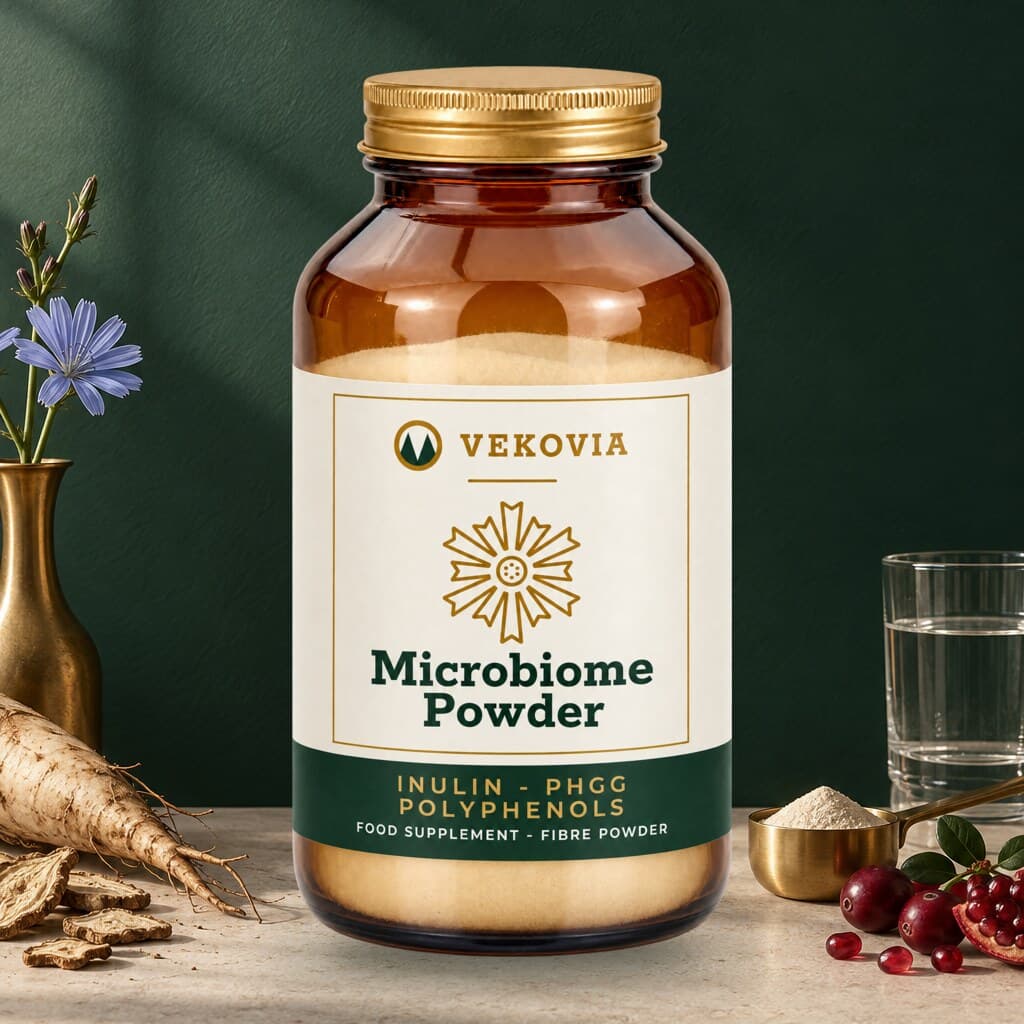
Most fibre supplements contain one fibre. Ours contain two, and not because a longer ingredient list looks better on a label — the two behave differently in a colon, and the difference is the reason they are together.
Inulin: the one with the numbers
Chicory inulin is an inulin-type fructan: a chain of fructose units that human enzymes cannot cut, so it arrives in the colon intact and is fermented there. It is probably the most studied fermentable fibre in existence.
The evidence is unusually consistent on one point. A 2023 systematic review pooled fifty randomised trials with 2,525 participants and found that chicory-derived inulin-type fructans at 3–20 g a day reliably increased Bifidobacterium — in healthy people and in most patient groups — with beneficial effects on bowel-function measures in healthy adults (Nagy et al., 2023). When Vandeputte and colleagues profiled the whole community rather than one genus, in a double-blind crossover in adults with mild constipation, the shift was modest and specific: Bifidobacterium and Anaerostipes rose, Bilophila fell, and the fall in Bilophila tracked with softer stools and better constipation-specific quality of life (Vandeputte et al., 2017).
Then there is the dose that matters for the label. The European Union authorised one claim for chicory inulin — contributes to normal bowel function by increasing stool frequency — on the condition that the consumer is told the effect requires 12 g a day of native chicory inulin. In 2025 a double-blind, placebo-controlled crossover trial tested exactly that dose in people with functional constipation and found increased bowel-movement frequency, better constipation-related quality of life, and enrichment of butyrate producers (Puhlmann et al., 2025). Twelve grams is what Microbiome Powder contains, which is why its label carries the claim. Metabolic Powder contains 9 g, so its label does not.
PHGG: the one that is easy to live with
Partially hydrolysed guar gum is guar gum that has been enzymatically cut into shorter chains. Whole guar gum is a thick gel; PHGG dissolves clear, has almost no viscosity, and is fermented slowly. That slowness is its point. A fibre that ferments in a rush produces gas in a rush; PHGG produces less, more evenly, and is the fibre most often reached for when people find inulin hard going.
Its trials tell a quieter story than inulin's, and a useful one. In 44 healthy adults with a tendency to loose stools, three months of PHGG normalised stool form and raised Bifidobacterium, with no change in how often they went (Yasukawa et al., 2019). In 108 people with irritable bowel syndrome, twelve weeks of 6 g a day reduced bloating and gas compared with placebo, and did nothing measurable to the other symptoms (Niv et al., 2016). In 52 elderly care-home residents with chronic constipation, 5 g a day did not change stool frequency but did significantly reduce how often they needed laxatives (Chan et al., 2022).
Read together: PHGG is not a bulk fibre and does not behave like one. What it does, across three very different populations, is make the gut's output more normal and better tolerated. That is why it sits beside the inulin rather than instead of it.
Why both
Inulin does the heavy lifting — the bifidogenic effect, the authorised claim, the butyrate producers. PHGG makes the dose liveable and adds a second, slower substrate for a different part of the community. Fifteen grams of a single fast-fermenting fibre would be a harder scoop to take every day than twelve of inulin and three of PHGG, and the microbiome is not one organism with one preference.
None of this is a claim about Akkermansia. Neither fibre feeds it directly — we go through that evidence, including the trials that came up empty, in a separate post. What fibre does for the bacterium is indirect: a community that has fibre to eat leaves the mucus layer alone, and the mucus layer is where Akkermansia lives.
Start with half a scoop. Work up. Drink water. The rest is fermentation.
References
- Nagy DU et al. Effect of chicory-derived inulin-type fructans on abundance of Bifidobacterium and on bowel function: a systematic review with meta-analyses. Crit Rev Food Sci Nutr 2023. PMID 35833477. DOI · PubMed
- Vandeputte D et al. Prebiotic inulin-type fructans induce specific changes in the human gut microbiota. Gut 2017. PMID 28213610. DOI · PubMed
- Puhlmann ML et al. Chicory inulin at 12 g per day increases bowel movement frequency and quality of life in functional constipation: a double-blind placebo-controlled crossover trial. BMC Gastroenterol 2025. PMID 41233756. DOI · PubMed
- Yasukawa Z et al. Effect of repeated consumption of partially hydrolyzed guar gum on fecal characteristics and gut microbiota: a randomized, double-blind, placebo-controlled, and parallel-group clinical trial. Nutrients 2019. PMID 31509971. DOI · PubMed
- Niv E et al. Randomized clinical study: partially hydrolyzed guar gum (PHGG) versus placebo in the treatment of patients with irritable bowel syndrome. Nutr Metab (Lond) 2016. PMID 26855665. DOI · PubMed
- Chan TC et al. Effectiveness of partially hydrolyzed guar gum in reducing constipation in long term care facility residents: a randomized single-blinded placebo-controlled trial. J Nutr Health Aging 2022. PMID 35297467. DOI · PubMed