Longevity · 8 min read
Urolithin A, explained
Vekovia · 27 May 2026
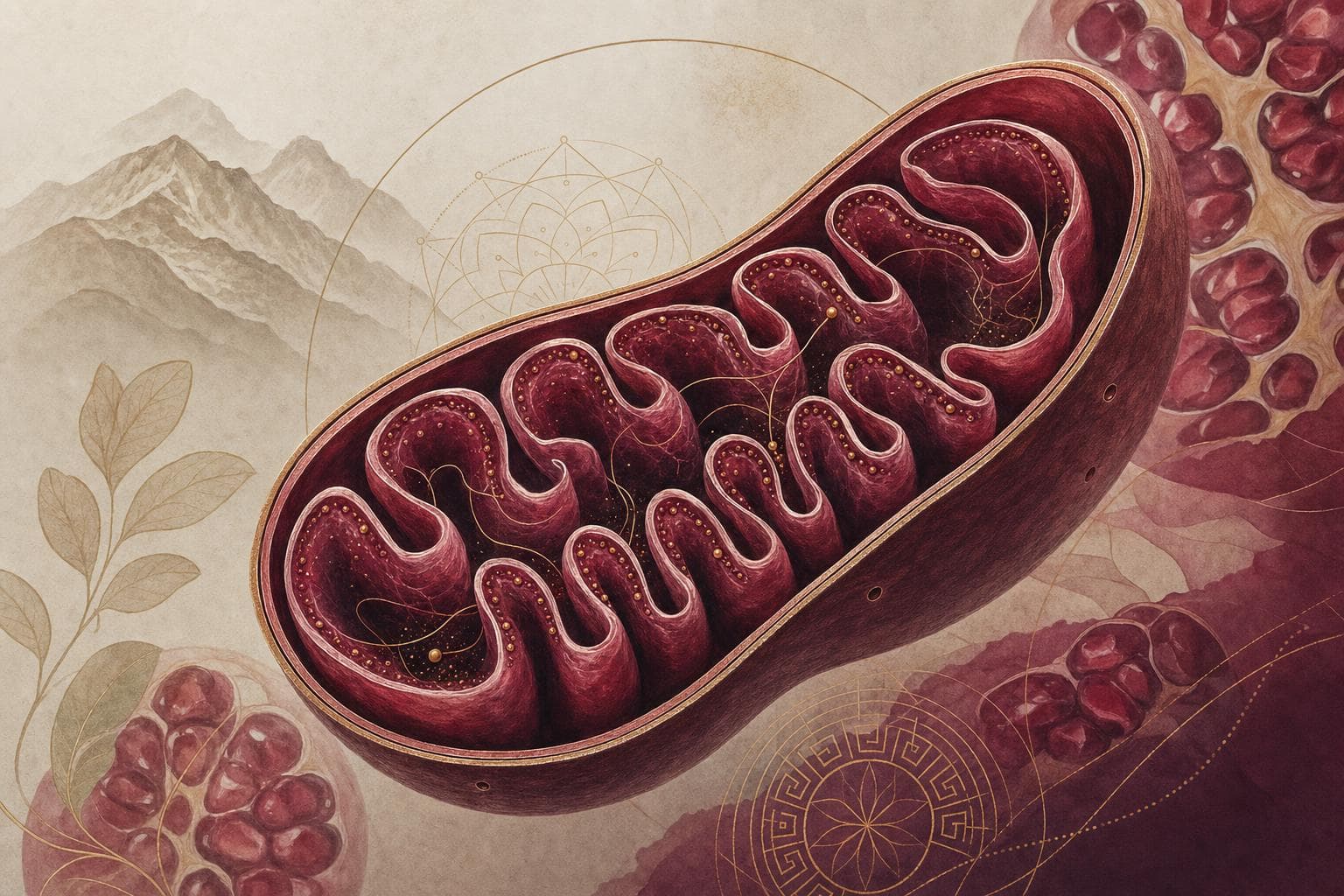
Urolithin A is one of those molecules that sounds like marketing invented it. It didn't. The compound is real, and its back-story is strange enough to be worth telling: your own cells cannot produce it, your gut bacteria produce it for you, and what it does inside cells has been measured in randomised human trials.
What it actually is
Urolithin A is a small compound produced when gut microbes break down a family of large polyphenols called ellagitannins. Almost no food contains urolithin A itself. You get it by eating ellagitannin-rich foods, chiefly pomegranate, and also raspberries, walnuts and other berries, then letting your gut bacteria do the conversion.
Not every microbiome does that conversion well. It depends on having the right microbial community, which is part of why one pomegranate can produce very different urolithin A levels in two people sitting at the same table.
How the gut makes it
The pathway runs in steps:
- You eat ellagitannins (for example, punicalagin from pomegranate).
- In the gut, these are hydrolysed to ellagic acid.
- Specific gut microbes then convert ellagic acid, through several intermediates, into urolithin A.
There is an Akkermansia connection at the front of that chain. In a 2017 study, pomegranate ellagitannins stimulated the growth of Akkermansia muciniphila in vivo (Henning et al., 2017), so the polyphenols that supply the substrate for urolithin A are also the ones linked to the bacterium we build around. Few food-to-microbe-to-metabolite routes have been traced this closely.
The mitophagy research
Serious scientific attention arrived with the work on mitophagy, the cell's housekeeping process for recycling worn-out mitochondria, the power plants inside your cells. As mitochondria age, clearing the damaged ones matters for how the cell keeps working.
In 2016, Dongryeol Ryu and colleagues showed that urolithin A induced mitophagy and extended lifespan in the worm C. elegans, and improved muscle function in rodents (Ryu et al., 2016). Read the model before the headline. Extended lifespan in a millimetre-long nematode is a real finding about a molecule and about cellular housekeeping, and it is not a statement about people.
The barrier research
A second strand runs back from the mitochondrion to the gut. In 2019, Rajbir Singh and colleagues showed that urolithin A enhanced gut-barrier integrity through the Nrf2 pathway in laboratory and mouse models (Singh et al., 2019). That is the same barrier Akkermansia helps maintain. The molecule sits in two stories at once, one mitochondrial and one intestinal. Both stories start from the same ellagitannins, which is why Vekovia · Pomegranate is built on the fruit rather than on the metabolite.
The human trials
Most ingredients sold under the word "longevity" have never been given to a person under trial conditions. Urolithin A has.
- In a first-in-human trial, urolithin A was safe and produced a molecular signature of improved mitochondrial and cellular health in older adults (Andreux et al., 2019).
- In a randomised, placebo-controlled trial in middle-aged adults, it improved muscle endurance and biomarkers of mitochondrial health (Singh et al., 2022).
- A 2024 systematic review pulled the human evidence together and assessed where it stands (Kuerec et al., 2024).
Those trials are well conducted, and they are narrow on purpose. The endpoints were biomarkers, muscle endurance and safety. Nobody measured "aging", because nobody yet knows how to.
The honest part
We make no anti-aging, lifespan or disease claims, for urolithin A or for anything we sell (why we stop there). The mitophagy and lifespan work is largely in cells and animals. The human trials are encouraging and small, built around defined biomarkers and muscle endpoints. "Studied for its role in mitochondrial health" is a fair sentence. "Reverses aging" is not.
What stands is this. Urolithin A is a microbe-made metabolite with an unusually well-mapped pathway and human data behind it, and pomegranate sits at the food end of that pathway. How much of it any particular person makes is still a question about their own gut, and not one a label can answer.
References
- Henning SM et al. Pomegranate ellagitannins stimulate the growth of Akkermansia muciniphila in vivo. Anaerobe 2017. PMID 27940244. DOI · PubMed
- Ryu D et al. Urolithin A induces mitophagy and prolongs lifespan in C. elegans and increases muscle function in rodents. Nat Med 2016. PMID 27400265. DOI · PubMed
- Andreux PA et al. The mitophagy activator urolithin A is safe and induces a molecular signature of improved mitochondrial and cellular health in humans. Nat Metab 2019. PMID 32694802. DOI · PubMed
- Singh A et al. Urolithin A improves muscle strength, exercise performance, and biomarkers of mitochondrial health in a randomized trial in middle-aged adults. Cell Rep Med 2022. PMID 35584623. DOI · PubMed
- Singh R et al. Enhancement of the gut barrier integrity by a microbial metabolite through the Nrf2 pathway. Nat Commun 2019. PMID 30626868. DOI · PubMed
- Kuerec AH et al. Targeting aging with urolithin A in humans: a systematic review. Ageing Res Rev 2024. PMID 39002645. DOI · PubMed