Mechanism · 7 min read
Akkermansia and the immune system: an honest look
Vekovia · 27 May 2026
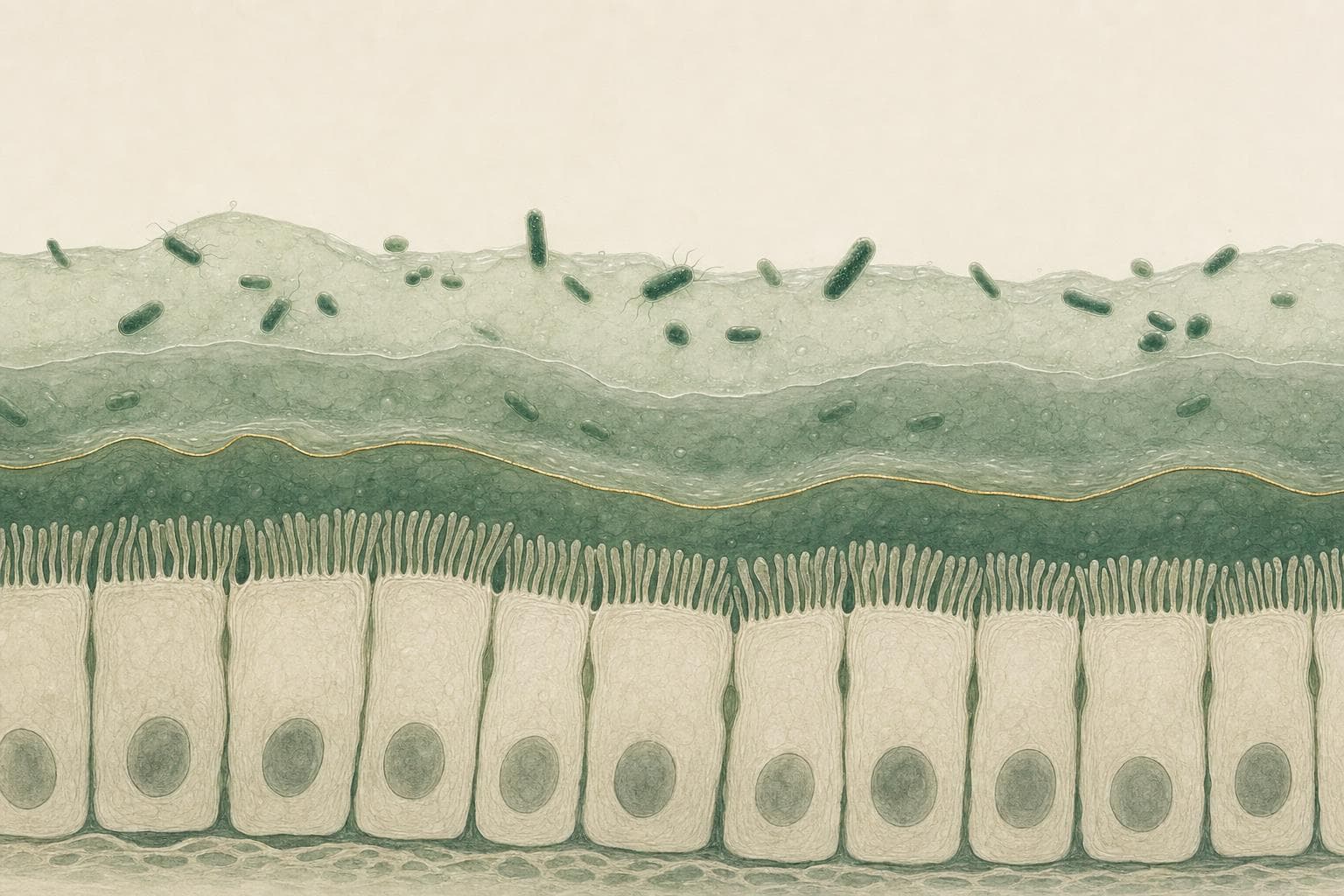
This is the post where we have to be most careful, because the topic is the one most prone to being mangled into a claim. Akkermansia muciniphila keeps turning up in immune research, including a study that made real headlines. So we want to walk through what that research actually says, and draw a hard line around what it does not say about a food supplement. Read this one as exploratory science, framed honestly.
Start with the barrier
The best-established link between Akkermansia and the immune system is a structural one. Akkermansia lives in the gut's mucus lining and contributes to its turnover and integrity (explained in detail elsewhere). That lining is, among other things, an immune interface: the surface where the contents of your gut meet the cells of your body. The two comprehensive reviews of the bacterium (Cani et al., 2022; Ioannou et al., 2025) return repeatedly to this barrier relationship and to Akkermansia's interactions with host immune signalling.
A bacterium associated with a well-maintained gut barrier sits, by definition, near the immune system's front door. Everything beyond that gets more speculative, and we'll flag it as such.
The 2018 immunotherapy study
The reason Akkermansia entered the immune conversation at all is a 2018 study in Science by Bertrand Routy and colleagues (Routy et al., 2018). They were studying cancer patients on a class of immunotherapy drugs called PD-1 inhibitors, and they noticed something. Patients who responded well to the treatment tended to have different gut microbiomes from those who didn't, and Akkermansia muciniphila was one of the bacteria more common in the responders.
It's an important finding, and it is worth understanding precisely what kind of finding it is:
- It's an association in humans, observed in cancer patients. The researchers saw that Akkermansia abundance travelled alongside better immunotherapy response. Association is not the same as cause.
- It's about people receiving a specific, powerful medical treatment, PD-1 immunotherapy, not about a supplement, and not about healthy people.
- It's about the gut microbiome's composition, observed in patients, not about anyone taking pasteurised Akkermansia in a capsule.
The study helped launch a whole research direction into how gut bacteria might influence immune-related treatment responses. That's why it's worth telling. It's also why it's so easy to misuse.
The line we will not cross
So let's draw it explicitly, because this is exactly the kind of research that gets twisted into something it isn't:
- Vekovia does not do anything to your immune system, and we make no claim that it does. "Boosts immunity" is authorised only for specific nutrients at specific doses, and Akkermansia is not among them.
- None of this is about cancer. The Routy study is research about gut bacteria in patients undergoing immunotherapy. It is not an implication that our supplement treats, prevents, or affects cancer or its treatment. Suggesting otherwise would be both false and prohibited.
- Association is not effect. A bacterium being studied in immune contexts is a reason scientists find it interesting. It is not evidence that consuming it produces an immune outcome in you.
This is the attribution-not-promises discipline at its strictest. We include the research because leaving it out would be its own kind of dishonesty, and we include it the way the literature treats it: as exploratory and observational.
Why we tell it anyway
The temptation with a study like Routy's is obvious. It is the most exciting-sounding paper in the whole corpus and the easiest to abuse. We tell it because credibility means describing the science as it is, including the parts that would sound better if we left the caveats off. The same discipline is why the page for Vekovia · Raspberry covers ingredients, provenance and the mucin-layer research, and says nothing at all about the immune system.
Akkermansia muciniphila is one of the most actively researched gut microbes of the decade, and its relationship with the immune interface is part of why. That is a fact about the science, and it stays a fact about the science.
References
- Routy B et al. Gut microbiome influences efficacy of PD-1–based immunotherapy against epithelial tumors. Science 2018. PMID 29097494. DOI · PubMed
- Cani PD et al. Akkermansia muciniphila: paradigm for next-generation beneficial microorganisms. Nat Rev Gastroenterol Hepatol 2022. PMID 35641786. DOI · PubMed
- Ioannou A et al. Akkermansia muciniphila: biology, microbial ecology, host interactions and therapeutic potential. Nat Rev Microbiol 2025. PMID 39406893. DOI · PubMed