Mechanism · 6 min read
What is Akkermansia muciniphila?
Vekovia · 22 May 2026
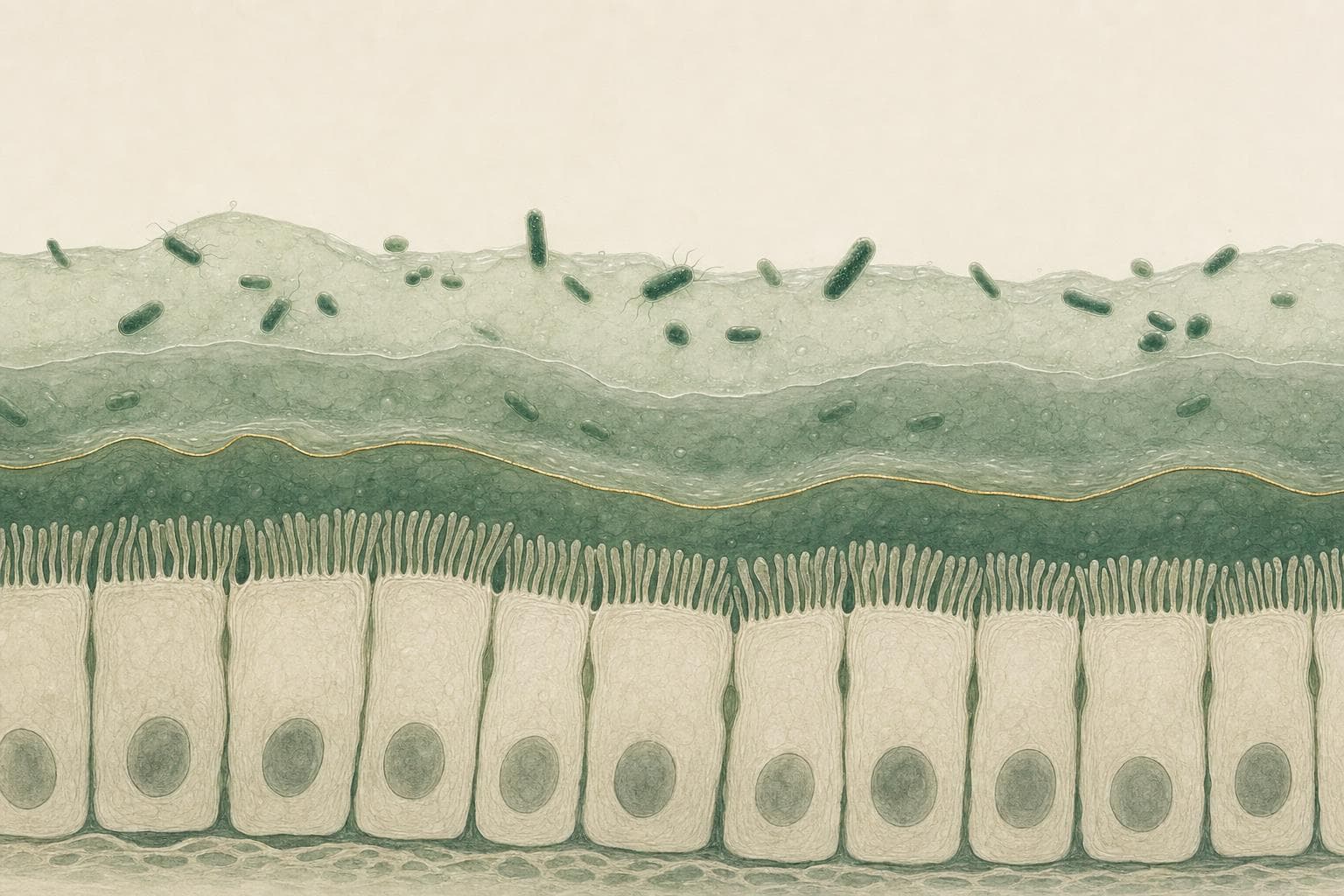
If you follow gut-health or longevity research, one bacterium keeps coming up: Akkermansia muciniphila. In two decades it has gone from an obscure 2004 discovery to the subject of more than two thousand scientific papers, two top-tier review articles, and a string of human trials. Most of the interest traces back to where it lives.
A bacterium named for where it lives
Akkermansia muciniphila was first isolated and described in 2004 by Muriel Derrien and colleagues, who named it for a striking habit: it lives in, and feeds on, mucin, the protein that makes up the protective mucus lining of the gut (Derrien et al., 2004). The species name muciniphila literally means "mucin-loving."
That sounds like a bad arrangement. A bacterium that eats your gut lining? In practice it runs the other way. As Akkermansia grazes on the outer mucus layer, it signals the host's own cells to produce more mucin, and a thicker mucus layer is associated with a stronger gut barrier.
Why the gut lining matters
Your gut wall is protected by a two-layer mucus barrier where Akkermansia lives, a story we tell in full elsewhere. When that barrier thins, bacterial fragments such as lipopolysaccharide (LPS) can cross into circulation and drive low-grade inflammation, a process researchers connect to metabolic problems. Akkermansia is one of the bacteria associated with a well-maintained mucus layer.
From a mouse study to a research field
The turning point came in 2013, when Amandine Everard and colleagues showed in mice that Akkermansia sits at the centre of a "cross-talk" between the gut bacteria and the intestinal lining that influences diet-induced obesity (Everard et al., 2013). Animals with more Akkermansia had a healthier gut barrier and better metabolic markers. Restoring Akkermansia reversed some of the damage of a high-fat diet. All of that was in mice.
That paper turned a quiet taxonomy finding into an active field. Two decades on, the bacterium has its own comprehensive reviews in Nature Reviews Gastroenterology & Hepatology (Cani et al., 2022) and Nature Reviews Microbiology (Ioannou et al., 2025), the kind of attention journals reserve for microbes the field considers important.
What we say, and what we don't
The research on Akkermansia is interesting, but most of it is in cells and animals; the human evidence, while growing, is still early. Vekovia describes what the studies found and stops there.
What can be said without hedging is narrower. Akkermansia muciniphila is a real, well-characterised gut bacterium, named for the mucus layer it maintains, and one of the most actively studied microbes in metabolic and longevity research today. That bacterium, pasteurised, is what goes into Vekovia · Raspberry alongside freeze-dried European raspberries.
Two questions come next: why the pasteurised form is the one that has been tested in humans, and what the protein it makes has to do with GLP-1.
References
- Derrien M et al. Akkermansia muciniphila gen. nov., sp. nov., a human intestinal mucin-degrading bacterium. Int J Syst Evol Microbiol 2004. PMID 15388697. DOI · PubMed
- Everard A et al. Cross-talk between Akkermansia muciniphila and intestinal epithelium controls diet-induced obesity. PNAS 2013. PMID 23671105. DOI · PubMed
- Cani PD et al. Akkermansia muciniphila: paradigm for next-generation beneficial microorganisms. Nat Rev Gastroenterol Hepatol 2022. PMID 35641786. DOI · PubMed
- Ioannou A et al. Akkermansia muciniphila: biology, microbial ecology, host interactions and therapeutic potential. Nat Rev Microbiol 2025. PMID 39406893. DOI · PubMed