Mechanism · 7 min read
How freeze-drying works (and why long space missions needed it)
Vekovia · 27 May 2026
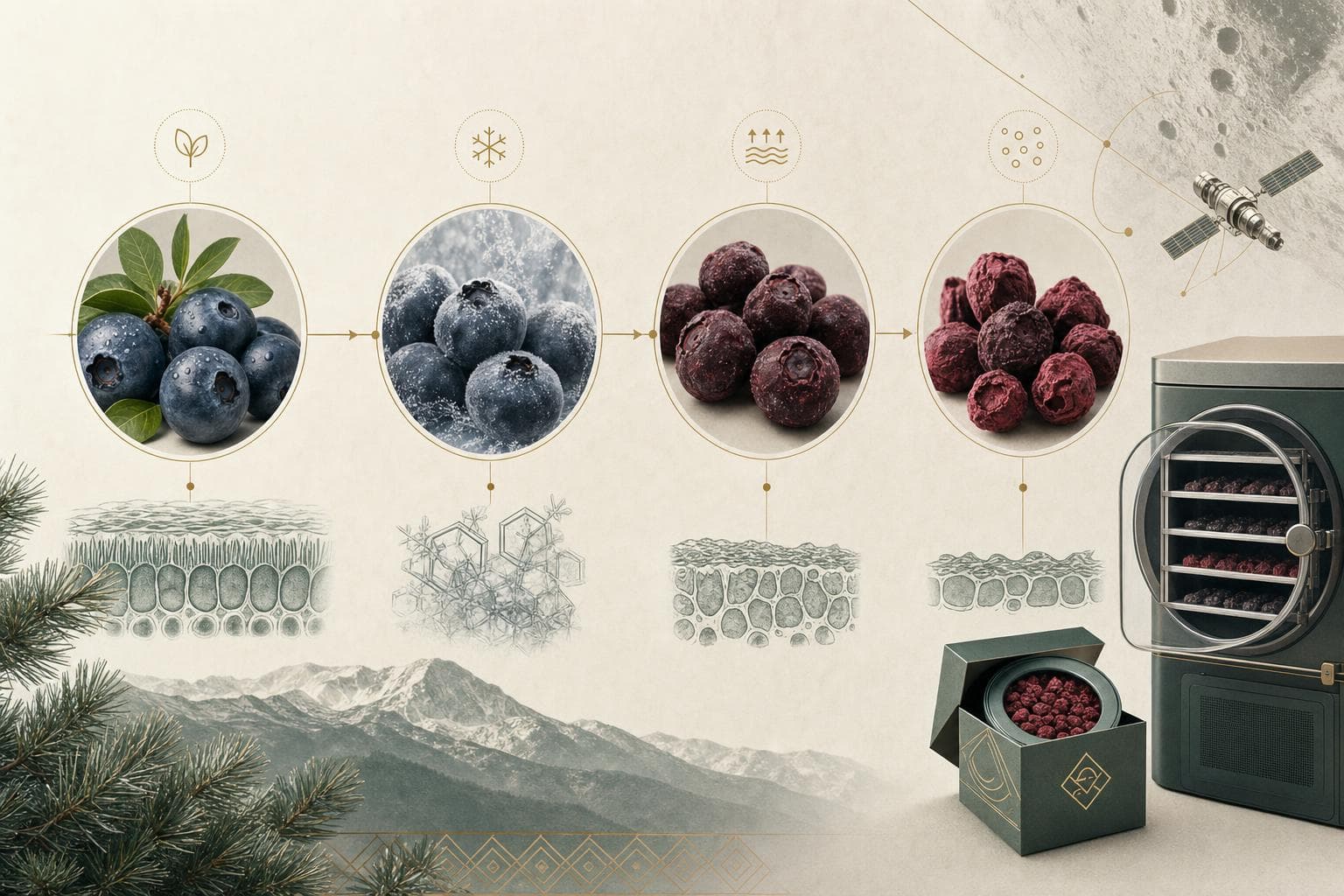
Open any pantry of long-life food and freeze-drying is somewhere in the story. The same is true of a Vekovia capsule. It is one of those processes that sounds futuristic and turns out to be simple physics, a way to take the water out of something without cooking it or chemically preserving it. For a supplement whose value lives in delicate surface proteins, that gentleness is the whole point.
The problem freeze-drying solves
Water is the enemy of shelf stability. It lets microbes grow, drives the chemical reactions that degrade ingredients, and makes anything heavy and perishable. The obvious fix is to dry things out, but ordinary drying uses heat, and heat damages exactly what we want to keep intact. Proteins are fragile in a particular way: warm them too much and they unfold and lose their shape, the way an egg white turns from clear to solid in a pan. Once a protein's shape is gone, so is its function.
Freeze-drying, whose technical name is lyophilisation, sidesteps the heat problem. Rather than boiling water away, it removes the water while it is still frozen.
The physics, in three steps
The process exploits a quiet trick of physics called sublimation: under low enough pressure, ice turns directly into vapour without ever becoming liquid. Skipping the liquid stage is what makes the whole thing gentle.
-
Freezing. The material is frozen solid, locking its structure in place. The water inside becomes ice crystals rather than a moving liquid that could carry things around or dissolve them.
-
Primary drying. The frozen material goes under a deep vacuum and is given a tiny amount of warmth, just enough energy for the ice to sublimate. The crystals turn straight to vapour and leave, hollowing out the material from the inside without melting it. Because the material never thaws, its physical structure survives almost exactly as it was when frozen.
-
Secondary drying. A small amount of stubborn water clings on at the molecular level. A gentle final stage coaxes that out too, leaving a dry, lightweight solid that can be sealed away for a long time.
The result is bone-dry and structurally faithful to the original. Add water back and freeze-dried food rehydrates to something close to its starting state, because the structure was never broken, only emptied.
Why this matters for a pasteurised bacterium
Vekovia uses pasteurised Akkermansia muciniphila, meaning heat-treated, non-living cells. That can sound like a contradiction with gentle, no-heat preservation. The two steps do different jobs: pasteurisation deliberately deactivates the bacterium, and freeze-drying then preserves what is left without adding further heat damage.
What is left turns out to be the part that matters, surface proteins such as Amuc_1100, the reason the pasteurised form works at all (Plovier et al., 2017; Depommier et al., 2019). If the value lives in surface proteins, any preservation step has one job, which is to keep those proteins intact and correctly folded. Taking water out without heat is what lyophilisation is for. The same step runs on both halves of every capsule in the Vekovia range, the pasteurised bacterium and the European berry beside it.
The space connection: process, not endorsement
Freeze-drying earned much of its fame through space programmes, which needed food that was light, kept for months without refrigeration, and came back to something edible with a squirt of water. Those are the constraints lyophilisation was built to meet, and it became a signature technology of that world.
We want to be precise here, because this is an easy story to misuse. Vekovia uses the same preservation method developed and refined for those missions. We claim no endorsement from any space agency, and none should be inferred. The connection is to the technique. It is a good story about how a clever bit of physics ended up in a capsule, and it is nothing more than that.
In the next post, we trace where everything in that capsule actually comes from.
References
- Plovier H et al. A purified membrane protein from Akkermansia muciniphila or the pasteurized bacterium improves metabolism in obese and diabetic mice. Nat Med 2017. PMID 27892954. DOI · PubMed
- Depommier C et al. Supplementation with Akkermansia muciniphila in overweight and obese human volunteers: a proof-of-concept exploratory study. Nat Med 2019. PMID 31263284. DOI · PubMed